The Science Adventure series is famous for incorporating real-life mysteries and conspiracies into its stories. And sumo stickers, one of the key mysteries of Chaos;Child, are no different. The game does not really emphasize that they were a real mystery, so many readers do not know that sumo stickers were an actual phenomenon in Japan. You can watch the video or read the article below it.
Different blog posts from 2008 and 2009 claim that the sumo stickers started appearing in spring of 2008 in Tokyo. Supposedly, they were 5–20 centimeters large and were plastered on random places in Ginza and Kagurazaka, which are both districts of Tokyo, roughly four kilometers apart from each other. Some commenters claim that they saw them in 2007 as well, but we have found no photos from that year.
Masahiro Kobayashi published a book in 2012 with a huge number of photos of sumo stickers. You can find the link for the e-book here. We would highly recommend checking it out, as it offers probably the best collection of photos of the sumo stickers.
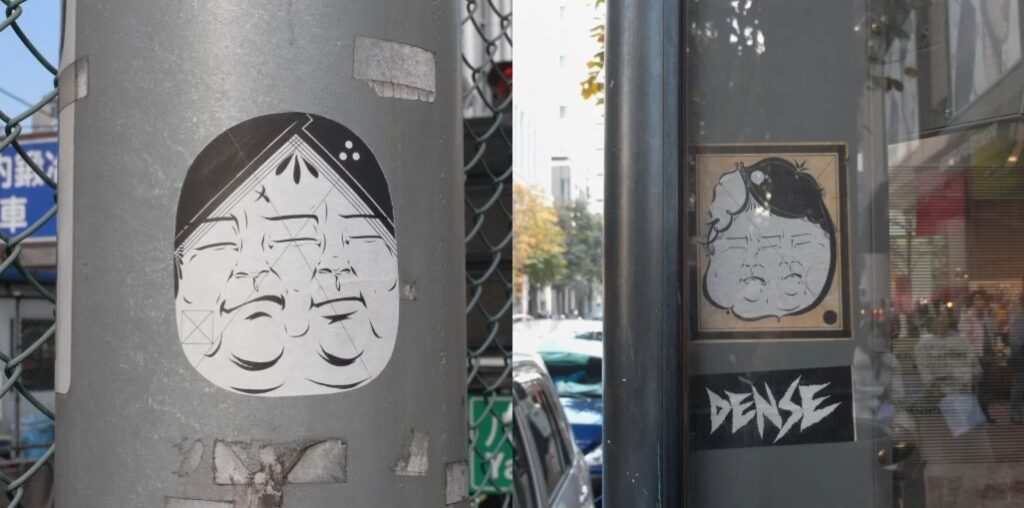
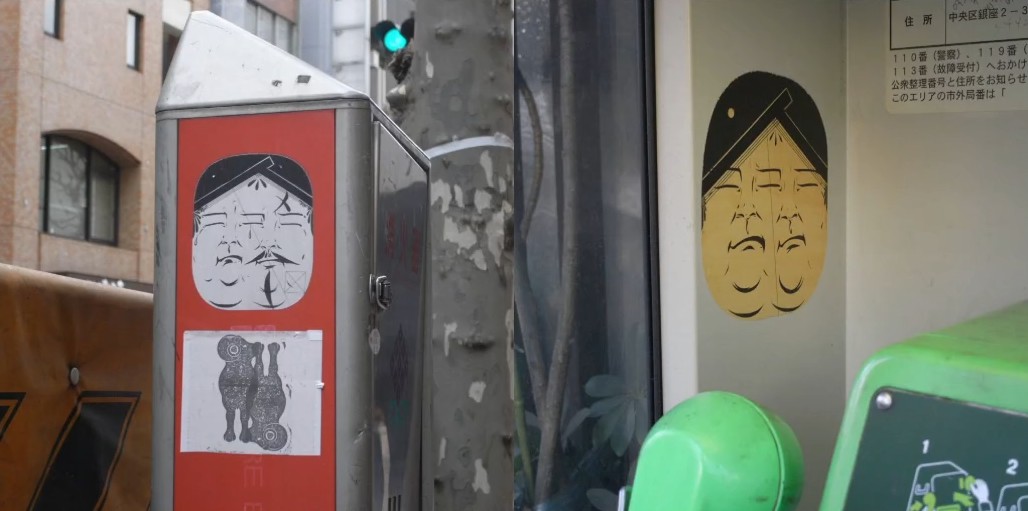
User “ism” on popular Japanese blogging website Ameblo claims that he had walked around Ginza station in 2009 and found over fifty stickers plastered over utility poles, guardrails, and telephone booths. While the photos made by this user are no longer available, he links a page where the user was investigating and documenting each sumo sticker. The page, called “Ginza Spy Investigation Office,” has several posts dating from January to December of 2009 from user “ginza-spy.” They took many photos of the stickers, mostly in Ginza.
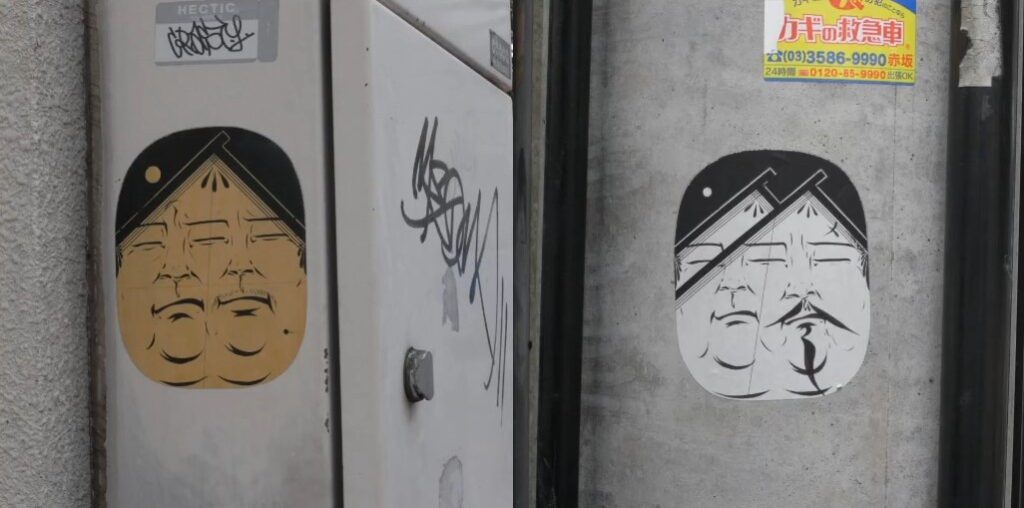
Each sticker has its own design. Some are small, some big, some have a rectangular background around them, and some are just the sumo head. Some of them have the same design as was featured in Chaos;Child.
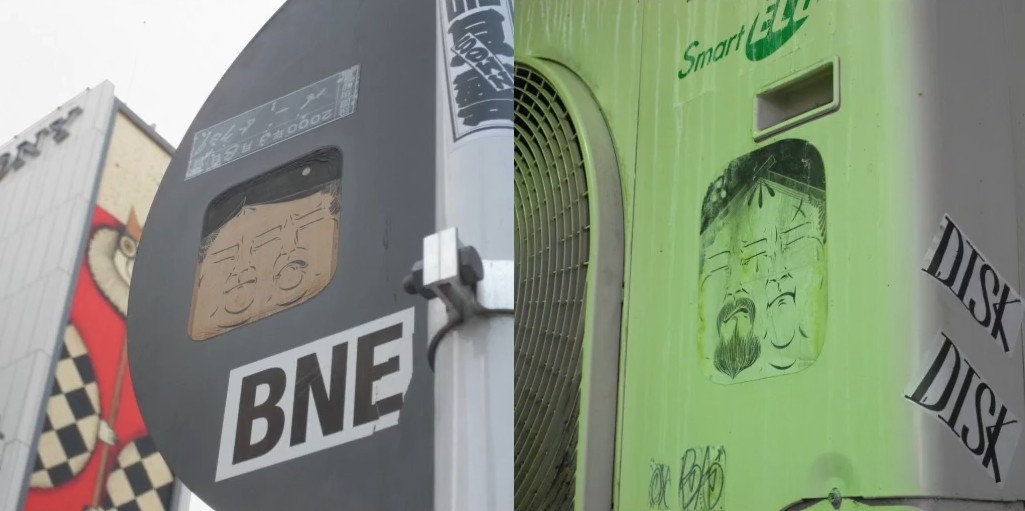
The Ginza Spy Investigation Office page goes really deep into the investigation. During 2009, they provided photos and even mapped locations of each sumo sticker on the map. Their last post was from September 2009, where they mentioned that the number of sumo stickers was decreasing and that they didn’t have enough time for the investigation anymore. We have found no indications that sumo stickers were still appearing from 2010 onward.
In Chaos;Child, whenever a Gigalomaniac sees the correct design of the sumo sticker, they start to feel very sick and experience delusions. “Ginza-spy” actually asked several passersby how they felt about the stickers, and some of them found them really disgusting and sickening. Were those people real Gigalomaniacs?
There’s also this news article from summer 2009 that talks about sumo stickers. While the article states that the stickers might be used for protecting Tokyo from the purported end of the world in 2012, they also talk about panda stickers appearing at the same time in the city of Fukuoka. We were able to find one post that did an investigation into the Fukuoka stickers, and they are covered in the same mystery as the sumo stickers. Panda stickers started appearing in the center of Fukuoka roughly in March 2009. The writer says that they are in hidden places, often covered with graffiti as well. At the end of the article, they also acknowledge that this is most likely just a piece of street art, rather than something with a connection to the occult.
Why stickers, though? In Japan, stickers are the main form of street art, unlike other countries. While it is normal to see graffiti over walls and trains in Europe and the Americas, in Japan, graffiti is not that prevalent. The reasons for this are varied. Japan has strict laws on vandalism and many street cameras, but there is also a large cultural difference from the West. Japanese tend to not like to permanently damage others’ property, even in the form of street art. And stickers do not damage property; they can be easily removed while still offering a similar form of expression as graffiti. Also, stickers are much more easily placed undetected than your typical sprayed graffiti.
Graffiti still exists in Japan, though it is not nearly as prevalent as it is in other countries. Thus, Japanese cities are often covered in stickers instead. They are cheap, fast to apply, and easily removed. Many street artists use stickers instead of spray cans. If you would like to know more about street art in Japan, we would highly recommend reading this article by Elena Calderón Aláez about street art in Tokyo, which explains in-depth why street art is so fundamentally different in Japan.
The identity of the sumo stickers’ creator remains unknown to this day. While posters on forums and blogs suggested a wider conspiracy on what these stickers mean, usually the simplest answer is the truth.
People who investigated the stickers often suggested two street artists as the main culprits: QP and Amanto. First, we will look at QP, which is short for “Querencia Peligrosa.” On this Flickr page, you can see plenty of their street art, from stickers to more traditional graffiti on walls. You can clearly see why someone would suggest that QP is the creator of sumo stickers; their art style is somewhat similar.
As for Amanto, meanwhile, we have not found any of their other art; most of the links with pictures no longer work. But according to the Ginza Spy Investigation Office, their art was very similar to the sumo stickers, so similar that they believed Amanto was the creator. They later attended an exhibition of QP’s art and offered a theory that Amanto and QP were the same person.
Probably the most interesting theory offered by online commenters at that time is that the sumo stickers were the work of several street artists who took inspiration from each other. That would explain the huge variety of designs: simply that each design was by a specific street artist.
No concrete evidence ever surfaced to pinpoint the sumo sticker outbreak to any specific street artist. Personally, I would like to believe that this was the work of several street artists who were just inspired by and iterated on each other’s sticker design. There is something cool about the idea that each design was created by a different person.
Whoever the creator is, and how many of them there are, they probably had no idea that five years later, the sumo stickers would become integral to the narrative of a legendary visual novel, sparking interest in the phenomenon again. And it is quite beautiful, too, that this forgotten mystery was brought back to life for a worldwide audience.
If you like this site, please consider supporting us on: