I often hear people describe Chaos;Child as a “perfect sequel” to Chaos;Head NoAH. And just as often, I hear people describe Chaos;Child’s true end, Silent Sky, as one of the greatest visual novel endings ever. But what if I told you that Chaos;Child itself had a sequel just as good as the main story? And no, I’m not talking about the sequel visual novel, Love Chu☆Chu. I’m speaking of Children’s Revive, one of the final major pieces of Chaos;Child side material ever released. Written by the game’s lead writer, Eiji Umehara, it’s an epilogue light novel for the main story and the ultimate send-off to the Chaos;Child subseries.
In all honesty, I do not think someone’s experience with Chaos;Child is truly finished until they read Children’s Revive. For as perfect of an ending as Silent Sky is, the main visual novel still leaves some loose threads that I imagine many fans would have been wondering about. At least, I did for the seven years between when I finished Chaos;Child and when I got around to reading Children’s Revive. After all, what happened to all the cast members after the end of the main game? That is the question that Children’s Revive addresses. Feel free to either watch the embedded video or read the article below.
Given its reception, for a good while, English-speaking fans campaigned to J-Novel Club to get Children’s Revive an official English release, eager to read such a highly acclaimed novel. Unfortunately, the company refused due to the poor sales of their localization of Occultic;Nine, whose third volume had a measly 21 preorders on Amazon at the time. But as of the day I’m publishing this article, it happens to be Chaos;Child’s eleventh anniversary. So I figured this would be as great an occasion as any to discuss what I believe is one of the greatest pieces of SciADV side material ever. Hopefully one day, it will see an official English release.
Spoiler warning for the main story of Chaos;Child
Children’s Revive is an incredibly heartfelt and cathartic end to the journeys of the entire Chaos;Child cast, taking place after the events of Silent Sky. It features six chapters, each focusing intently on one of Chaos;Child’s characters—specifically, Uki, Hana, Hinae, Mio, Senri, and Serika. In between the first several of those chapters are also intermissions from Senri’s perspective. So it’s fully a character story—in a manner that doesn’t make it feel very SciADV-like—and yet it’s also just as thematically rich as the series’s mainline entries.
I think the main story of Chaos;Child is already extremely character-focused as it stands, but I still hear some occasional complaints from readers that some of the side characters are a little undercharacterized in the main game. I can assure you that you probably won’t have those sorts of complaints with Children’s Revive. It is entirely focused on the cast and the social commentary. This novel is like a character study on everybody other than Takuru. I don’t think the social commentary in Children’s Revive is as strong or prevalent as it is in the main game, but it definitely builds off of what the main game establishes. And there’s certain moments in the novel that heavily recontextualize what Chaos;Child is about thematically. At the end of the day, what Children’s Revive hammers home is that the villain of Chaos;Child is not truly Serika, Sakuma, Wakui, or even Takuru himself. It’s society.
In all honesty, because of how pivotal the content of this novel is, part of me wishes MAGES. included its contents in the main game. And the ironic thing is that the other Chaos;Child game that did come into fruition is self-admittedly an almost entirely superfluous addition to the series storyline—a sequel Chaos;Child did not need. While it does have a tiny bit of setup for later entries and does tie in with some overarching series themes, the majority of Love Chu☆Chu serves little purpose. Meanwhile, Children’s Revive, the sequel with legitimately vital content, is just side material that most people end up skipping. But let’s go over that content, shall we?

Spoiler warning for the entirety of Children’s Revive
From the very beginning of the story with Senri’s heartfelt letter to Takuru, I was hooked. And past that point, once we got into the character-focused chapters, I was so pleasantly surprised by how compelling they were. As much as I love the main game, one of my biggest gripes with it is that the character routes are a bit inconsistent in quality. And despite having those entire chapters dedicated to character exploration, I just did not find every character in the main story to be equally compelling. But what Children’s Revive did was make even some of the most stale characters from Chaos;Child immensely profound. And honestly, I wasn’t expecting that at all from the likes of Uki and Hana, the latter of whom was a very last-minute addition to the story of Chaos;Child in the first place. And yet they have some of the strongest chapters in the entire novel—stronger than a lot of mainline SciADV in my opinion.
Normally, I’d conduct a review giving a breakdown of what I liked and disliked, but to be honest, there was hardly anything I could think of in this novel that I didn’t like. So I’ll give my thoughts on each of the novel’s chapters one by one.

Uki Chapter
First up, the Uki chapter, which focuses on the Aoba Dorm siblings in the aftermath of Takuru’s arrest. What are their lives like being the siblings of both a murder victim and the so-called perpetrator of said murders? How does society treat them? How do they survive without Sakuma around to fund them? What are their dreams? What is it that they hope to achieve in their lives? This chapter addresses all those questions, showcasing the challenges they face in the aftermath of Takuru’s arrest. From Uki to Yuto to Senri, everyone is characterized incredibly. And in addition, this chapter also introduces one of my favorite characters in the entire Chaos; series: Komori. Komori is introduced as a caregiver, but she’s secretly an officer from the community safety division of the Tokyo police, trying to gather more information about the family. And the interactions between Komori and the guarded Aoba Dorm siblings are a real treat to read; the way their relationship shifts from amicable to tense to amicable again is unbelievably compelling. It’s especially moving emotionally to see the tension when Komori badmouths Takuru, entirely in the dark about the truth behind the murders. And then afterwards, the scene where Komori confronts the boy who assaulted Yuto is incredible. I gained so much respect for her there.
But by far, my favorite part of Komori’s interactions with the cast in this chapter is in a series of conversations centered around adulthood. Komori repeatedly emphasizes that Senri, despite only being 19, acts like way more of an adult than herself. And eventually, Senri comes to ask what it means to become an adult in the first place. Is it when you turn 20? Is it when you’re financially independent? When? And in this conversation, she gives a bit of insight that completely recontextualizes what Chaos;Child itself is actually about. After all, why is Chaos;Child called Chaos;Child in the first place? It’s not just because of Chaos Child Syndrome—it’s because the story is fundamentally about what it means to become an adult. As Senri sums it up: “[Takuru] defeated [Chaos Child Syndrome] because he became an adult.” And that’s genuinely so poetic—that Takuru broke out of the delusion synchro and Chaos;Child ended when it did because he was no longer a child. That gives the original game and Takuru’s arc a whole new meaning. What an amazing start to the novel.

Hana Chapter
After the Uki chapter is Hana’s, which was yet another surprise. For the majority of the main game, Hana is left in the background not doing or saying much. Yet in Children’s Revive, we get an entire chapter dedicated to her… actually making a friend: a girl named Hatsuyama Mizuki. At first, it just seems she’s sweet and that the two of them have a common interest in video games. But as it turns out, Mizuki has this very twisted perception of Takuru and Itou, believing both of them to be guilty and yet still revering them as “gods living among mortal men,” insinuating that they served this greater noble purpose to send a “warning message” to society telling them to “wake up.” Such would tie in to the main game’s themes on internet culture and the world in an age of misinformation, with how desensitized the internet and, really, a lot of society is to the horrific loss of people’s lives. After all, it’s not just Mizuki but a whole subset of the internet that genuinely believes in those kinds of conspiracy theories.
But hearing Takuru and Itou badmouthed and mischaracterized by Mizuki of all people makes Hana absolutely furious. And that was honestly so incredible to see, because it shows just how much they meant to her. For the other remaining members of the Newspaper Club, they’d more or less gotten used to the Takuru badmouthing by society—but not Hana. It drives her crazy. And so she ghosts Mizuki, as I imagine any of us would. But when she suddenly disappears off the face of the planet, seeing Hana run off to find her in spite of those feelings was just so amazing to see. And the confrontation between Hana and Mizuki was one of the best parts of the novel. As it turns out, Mizuki shut herself indoors, not just because of the falling-out between her and Hana, but because people had been secretly taking pictures of Mizuki, doxxing her and mocking her condition on the internet. But all the while, she still clutches on to this baseless image of Takuru and Itou, as if that would make any difference in the doxxing and harassment. And in this exchange, Hana stands up to Mizuki and challenges her beliefs, not for the sake of herself or defending Takuru, but for Mizuki’s sake. My goodness, that was when I really came to appreciate Hana as a character. And I also increasingly appreciated Mio as a character with her anti-doxxing actions right afterward too. What an incredible moment, and what an incredible chapter.
What I’d say would have to be my single favorite part of the chapter, though, is this one-off line from Hinae: “The more you treasure something, the more willing you must be to part with it—lest your imparted value begin to damage the very treasure you hold so dear.” This idea is central to Silent Sky and the relationship between Takuru and Serika. But reading those words laid bare like that changed not only the way I looked at the main story of Chaos;Child, but also my own life as well. I think I needed to hear those words a lot sooner than I actually did.
As I’m sure a lot of you know, I grew up constantly moving from country to country and from city to city. And while I’d more or less been used to saying hello and goodbye to people all my life, one of my most recent moves—the move after finishing my undergrad—really gutted me because of how close I’d become with my friends there. After leaving, I would constantly have dreams about seeing them, and I would yearn to be with them again. Every few months, whenever I’d have the opportunity, I’d take a weekend trip back just to visit them. But in doing so, I had increasingly come to feel as though I was returning to a place that was no longer my home. And that is where I feel like I was tarnishing a treasure I once held. That sense of closeness I felt with my undergrad friends had somewhat wavered. For the year after finishing my undergrad, I was just working, hardly ever going out to meet and socialize with people. But my friends from my undergrad, who hadn’t moved, were hanging out with one another day after day for an entire year. And that time can make a huge difference.
At the end of the day, I’d been holding on to these sentiments and perceptions of others that I needed to let go of a lot sooner than I did. If I hadn’t taken so many trips to visit, I don’t think I would have somewhat diminished the value of the treasure I once held. So sometimes, you do need to let go of the people you care deeply about. And it’s crazy how it’s a line from Hinae of all people that made me internalize that.

Hinae Chapter
Speaking of Hinae, let’s move on to discussing her chapter, which continuing off the trend established by the first two chapters, was also superb. Honestly, I think Hinae underwent more character development in this chapter than in the entirety of the main game. At this point in time, Hinae is no longer able to tell truth apart from lies in people’s words. And more than not being able to navigate the world the same way she used to be, she’s also completely unsure what she’ll do in the future, a sentiment to which I have definitely related to at earlier points in my life. And the way she finds herself and figures out what it is she wants to do with her life is incredibly inspirational.
Building off of what the previous chapters established, Hinae and the other former Newspaper Club members started up the SBSAC (or Students for the Betterment of Student Autonomy and Conditions). And their group dedicates itself to improving the lives of CCS victims. So, like the previous two chapters, this one also delves heavily into commentary on society and its treatment of victims of natural disasters and those with disabilities. And I think there’s really two major highlights of this chapter that stuck with me.
The first was the series of interactions between Hinae, Senri, and the two boys they’d been seeing, Keisuke and Kota. It was very sweet to see Hinae and Senri move past Takuru’s arrest and navigate platonic and romantic relationships, even if the girls didn’t really like the boys romantically in the end. Even the more serious discussions between the four of them are some of the most compelling from the Chaos;Child subseries. The one they had on being ghosted from a part-time job really stood out to me because in spite of all the legislative protection that marginalized groups of people have on paper, in practice, they face all sorts of discrimination and challenges in the workforce—all over the world. And having two brothers with disabilities, I don’t think what’s presented in the novel is unbelievable or hyperbolic in any way. The novel’s showcase of the opposite perspective with Keisuke’s mother and the school staff was also pretty realistic in my eyes. In-story, they don’t see CCS patients and Hekiho students as human beings capable of making their own decisions, but rather as mere victims. And in doing so, they often bypass the children’s opinions and experiences, even though they’re the ones living with their conditions.
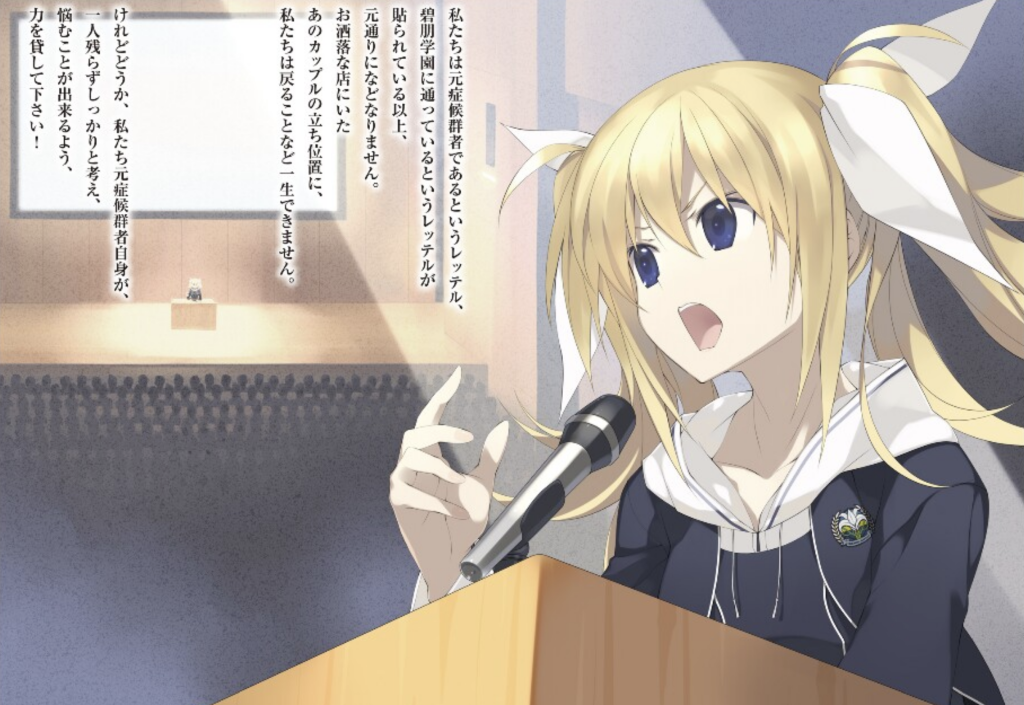
And that leads into the second main highlight of the chapter, Hinae’s speech. Genuinely, that was incredible—easily one of the most memorable parts of Children’s Revive. In the spur of the moment, she delivers a legendary speech culminating in a call to action and for collaboration from parents and faculty. But at the crux of her speech was storytelling. As Senri tells Hinae just before it’s time to deliver her speech, “When you wish to convey something to an audience, all you truly need to get your point across is a story, and a few concrete examples to reinforce it.” And she takes it to heart, using personal storytelling with the example of all the societal and mental bullshit they had to deal with going on a double date. Her speech sure captivated the in-story audience. But it also captivated me—as did Senri’s advice there. I definitely need to heed those words myself. All in all, this was another amazing part of Children’s Revive.
Mio Chapter
Moving on from Hinae’s chapter and into Mio’s chapter—the chapter of the novel that made me cry.
From the get-go, this part of the novel engages heavily in characterizing Mio. After all, she’s a central focus in the majority of Chaos;Child side material, and this chapter is like a culmination of all the development she’s undergone over the course of the subseries: her upbringing, her experiences at the Coleman Institute, her journey throughout the main story of Chaos;Child, and of course, everything she undergoes in Love Chu☆Chu.
Yet even so, the highlight of this chapter has little to do with Mio at all—it’s the reunion she sets up between Yuto and Itou. I’m sure a number of us were wondering how Yuto felt about what Itou had done to Yui. Itou may not have been in his senses, but it was ultimately his body that was used to murder Yui. When they met again, as expected, Itou was unable to so much as look Yuto in the eye out of pure guilt. But what does Yuto do? It would have been perfectly understandable if he lashed out in pure hatred. But no, he gives him a hug, crying out that it wasn’t his fault. And no matter how many times I read this scene, I can’t help but become an emotional wreck. What an unbelievably cathartic moment—probably the novel-defining scene.
Senri and Serika Chapters
And lastly, there’s the Senri and Serika chapters, both of which are extremely short. The Senri chapter is just another brief, yet deeply emotional letter to Takuru, like the earlier intermissions. But in the end, it doesn’t feel like her chapter’s length matters, because she already had all the earlier intermission chapters to herself and remained a prominent figure throughout other chapters of the novel. And one thing I like about Senri’s chapter is that, despite being presented in the novel before Serika’s chapter, it was written afterward, reflecting her perspective of their final encounter. In that sense, perhaps it does feel worthy of being a numbered chapter, because it’s the ending of the novel presented from one perspective. And I feel as though that makes the final, Serika chapter feel so much more meaningful that way. Serika’s chapter is only just a bit longer than Senri’s, but it shows what she’s up to after Silent Sky and also reaffirms its conclusion in that she needed to be apart from Takuru and the original game’s cast. And now she’s living her own life with her own new friends, as a normal girl, just as Takuru wished for.
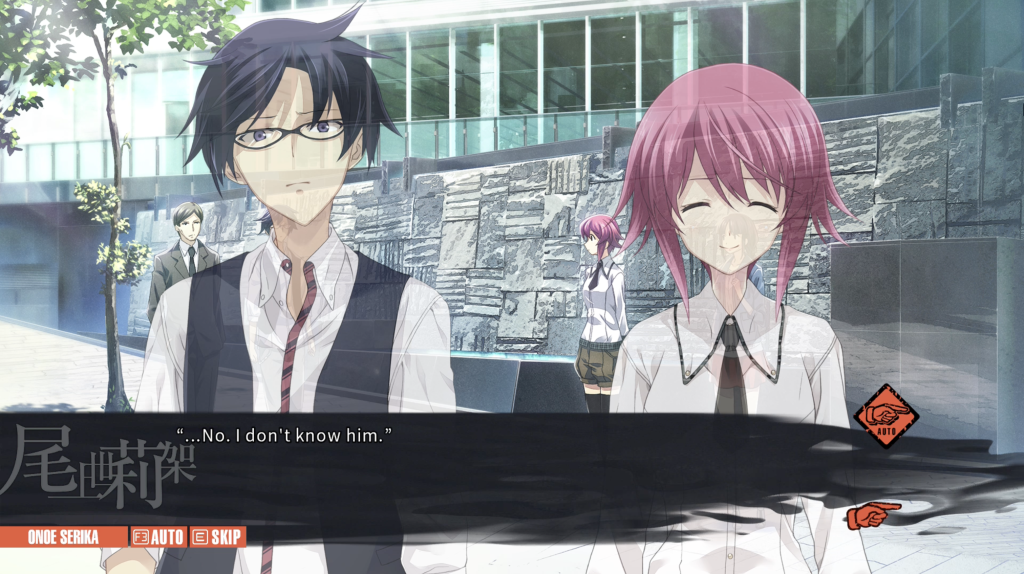
While not as gut-wrenching and memorable as Silent Sky’s ending, I felt it was a very fitting send-off to the characters and story of Chaos;Child. It reminds me of just how much the game and its themes really meant to me. And I think it was a needed addition to Chaos;Child’s story.
Special thanks to ChrisGLink, BlabbityBla, Enorovan, and Fasty. Once again, happy eleventh anniversary to Chaos;Child.
If you like this site, please consider supporting us on: