
When Robotics;Notes originally released in 2012, it already stood apart from traditional visual novels. Developed by MAGES. and led by Chiyomaru Shikura, the game experimented with 3D character models and augmented reality interfaces, and a world that felt just a little closer to reality, while still being futuristic.
Yet only two years later, Robotics;Notes Elite was released, not as a sequel, but as a reworked version of the same story. In a 2012 interview by Dengeki Online, Shikura repeatedly emphasizes that Robotics;Notes aimed to depict a more dynamic, visually expressive world than earlier entries like Steins;Gate. The shift to 3D models was already part of that ambition. However, the original game still relied heavily on static presentation and limited animation.
The anime adaptation had already been announced at the time, and Shikura expressed particular interest in it, noting that animation could provide a level of movement and presentation the visual novel itself could not. This interview was posted just a few days before the release of the visual novel on PS3 and Xbox 360. The game had high expectations from the Japanese audience, as it was only one year after the release of the highly acclaimed Steins;Gate anime, and many fans were looking forward to what would come next for the Science Adventure series.
The game ultimately garnered a more mixed critical response. While reviewers and players praised its ambition, particularly its use of 3D character models, near-future setting, and focus on augmented reality, it was often seen as an uneven successor to Steins;Gate. Many found the pacing slow and the early chapters overly slice-of-life, which contrasted with expectations for a more immediately gripping narrative. The presentation, despite being technically innovative, was also criticized for lacking dynamism in key emotional scenes. As a result, the game was generally regarded as a bold but imperfect evolution of the Science Adventure formula rather than a clear step forward.
The reception of the anime released a few months later was almost exactly the same. People were praising the concept, characters and the worldbuilding, but cited pacing issues and lack of narrative impact compared to Steins;Gate.
Instead of focusing on the next installment in the series however, MAGES. and Shikura looked at fixing the issues with Robotics;Notes, while also bringing it to a new platform. Earlier in the same year, Sony released now infamous new handheld called PlayStation Vita, highly anticipated successor to the legendary PlayStation Portable.
While the console would later struggle commercially, at the time it was seen as a powerful and promising handheld. With dual touchscreens, motion controls, and built-in cameras for augmented reality, Vita’s capabilities closely mirrored the kind of device depicted in Robotics;Notes. In many ways, it felt like the ideal platform for the game’s core concepts.
In July 2013, Famitsu announced that Robotics;Notes will be ported on the PS Vita. No more details were shared, just that it would be released in winter. No further updates were shared and the winter release date was missed. Then in March of 2014, Famitsu reported that the PS Vita port will be much more than just a port, but a complete upgrade.
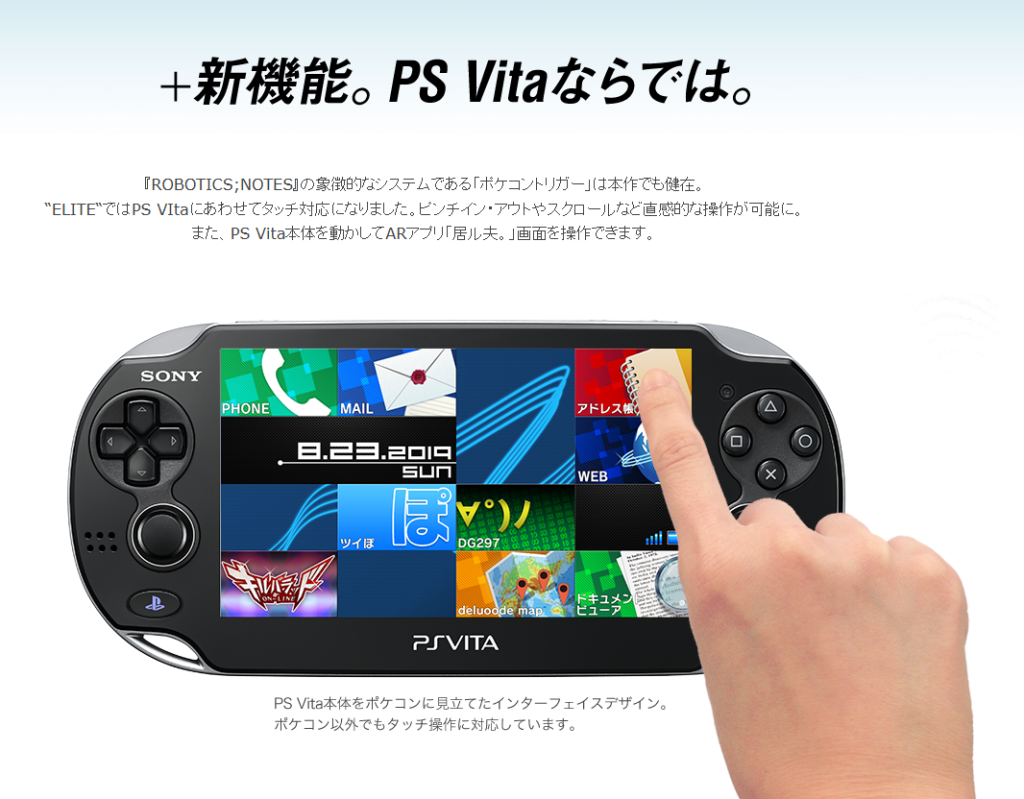
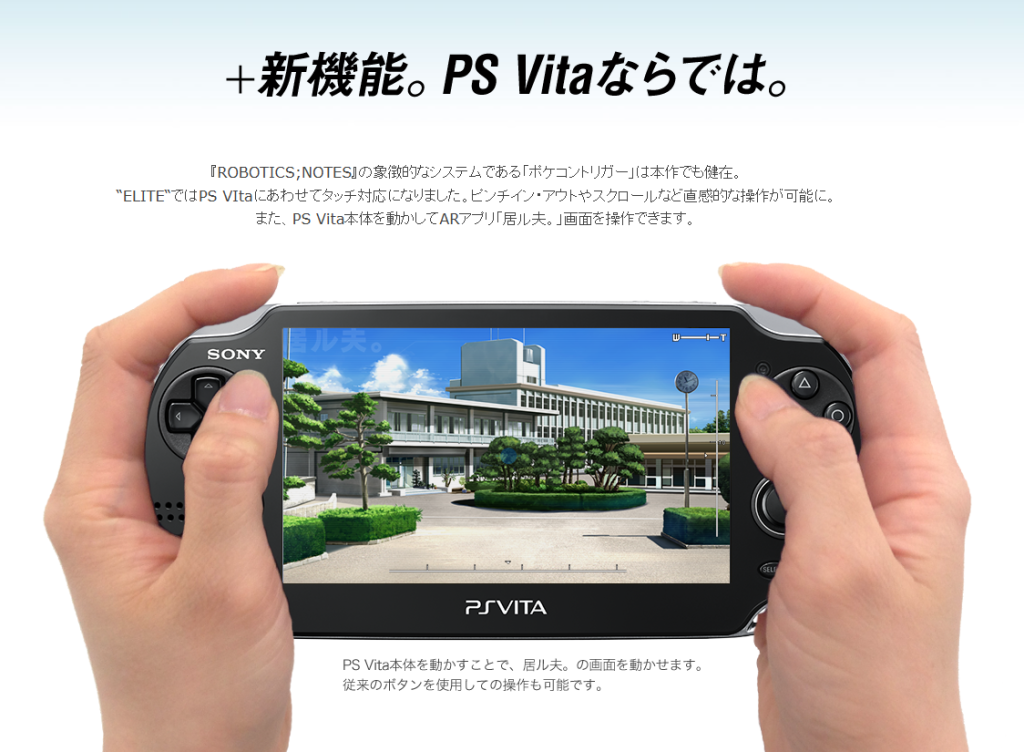
Promotional images showing using PS Vita’s touchscreen and motion sensors
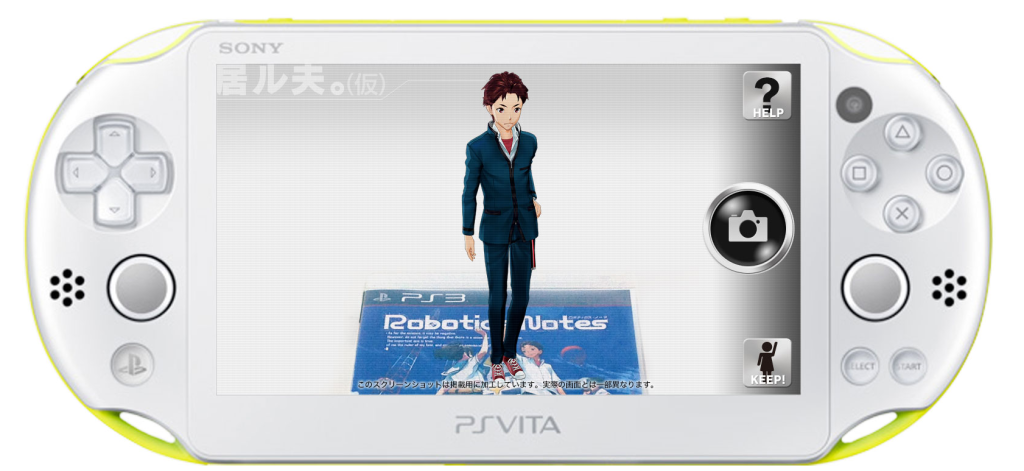
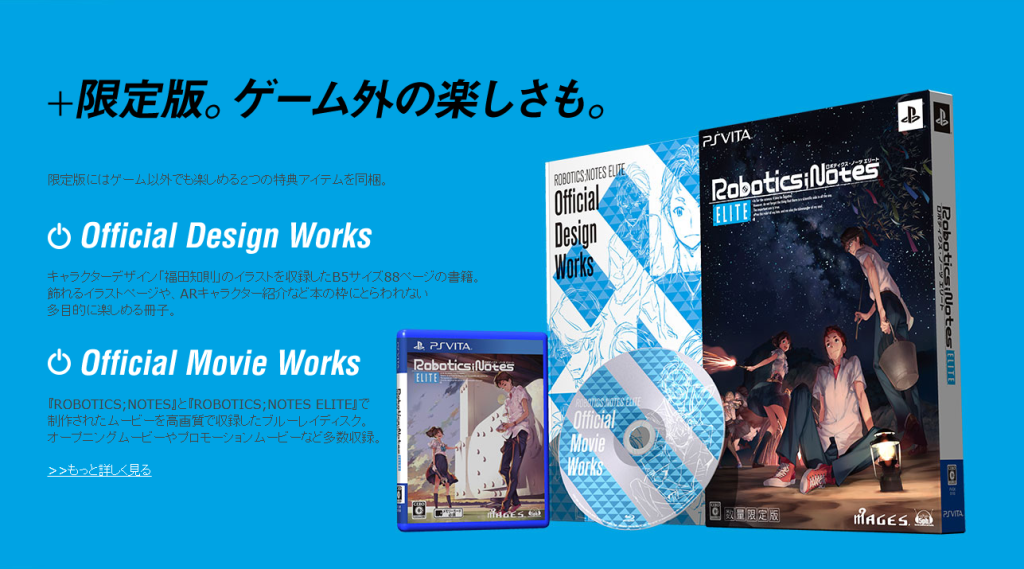
The reveal was done through the Weekly Famitsu magazine, which featured much more information about the re-release, announced the “Elite” name, restructured storyline and showed screenshots of updated character models. Few weeks later 4gamer ran a news article showing the visuals, as well as screenshots from the newly animated scenes, which were taken from the anime. They also talk about limited edition bonuses, which included a series of images which could be used through the PS Vita’s AR app to inspect character models. Another bonus was a Blu-ray disc featuring animated scenes from the game, and there were also some store-specific bonuses, mostly featuring character art.
In June 2014, the game was released and was received as a solid refinement of the original game rather than a huge upgrade. Critics and players generally praised the improved presentation, especially the addition of anime cutscenes and smoother scene flow, which helped address some of the original’s stiffness and made emotional moments land more effectively. The move to the PlayStation Vita was also seen as a natural fit, enhancing immersion through touch-based interaction. However, many of the original criticisms remained, particularly the slow pacing and less impactful narrative compared to Steins;Gate. As a result, Elite was widely regarded as the definitive version of Robotics;Notes, but not a dramatic re-evaluation of its overall standing within the series as MAGES. hoped.
We don’t know how many copies MAGES. sold for PS Vita. By the time of its release, they were focused on the next SciADV title, which would change how the whole series is made. Also by this point PS Vita’s future was already sealed, as sales in the west plummeted and developers stopped developing games. While Japanese developers kept releasing titles, it was nowhere near the success of PSP. Finally, PS3 and Xbox 360 lifespan was coming to an end, as the PS4 and Xbox One were already out.
Thus Robotics;Notes Elite was locked to a console which sold badly, and the previous version of the game was locked to aging consoles which were being replaced. This meant that even many Japanese fans could not play Elite until 2019 when this version was ported to PS4 and Nintendo Switch.
In 2020, we would get a worldwide release for PS4, Switch and PC, which finally allowed everyone to experience the game. At the time, the 2020 release was often seen as a major moment primarily for Western audiences. In reality, it was just as significant in Japan. After years of limited availability, players all over the world could finally experience the definitive version of the game on modern platforms.




KKB Community
0 comments