
The idea of a shadowy group pulling strings to influence the world’s politics, economy, and social structure has long fascinated both conspiracy theorists and fiction writers alike. For fans of the Science Adventure series, this topic immediately brings to mind the series’s main antagonist: the Committee of 300. You can watch the video or read the article below.
This article and video contains spoilers for Steins;Gate and Chaos;Head
Interestingly enough, this isn’t a made-up organization for the purpose of the story; the Committee of 300 is a real conspiracy theory, although it’s far less mysterious than other similar conspiracies.
The phrase can be traced back to 1909, when German industrialist and politician Walther Rathenau wrote about “three hundred men” who controlled the economic fate of Europe. Rathenau was not describing a specific secret society but criticizing the concentration of power among economic elites. His statement reflected concerns about early capitalism, not a coordinated hidden organization.
Over time, however, the idea was distorted, and Rathenau’s words were reinterpreted as evidence of a hidden ruling class. What began as social critique gradually evolved into a broader conspiracy narrative, one centered on the idea of a secret elite controlling global events from the shadows.
The modern version of the “Committee of 300” is most closely associated with John Coleman and his 1992 book Conspirators’ Hierarchy: The Story of the Committee of 300. In it, the Committee is portrayed as a powerful group allegedly controlling governments, economies, and global affairs.
If you try to track the book down online, you might stumble upon something unexpectedly ironic: it’s hosted on the official website of the Central Intelligence Agency.

Yes, the CIA. Not because they’re secretly confirming the theory, but because the book was part of a massive document dump following the 2011 raid on Osama bin Laden’s compound. Among the files recovered was his personal digital library, which included a wide range of conspiracy books like Coleman’s. The CIA later published these materials for transparency, not endorsement. The irony of a conspiracy book about a shadowy organization being hosted by one of the world’s most famous intelligence agencies, after they recovered it from the personal computer of one of the world’s most notorious terrorists, is hard to ignore.
The book opens with Coleman claiming a background in intelligence work before laying out his central ideas. According to his theory, the Committee exists above all governments, acting as an “ultimate controlling body” that directs global events from behind the scenes.
One of Coleman’s most extreme claims is that this group seeks to drastically reduce the global population. Wars, famine, and disease are framed as deliberate tools used to eliminate what are described as “surplus” populations. Closely tied to this is the idea that industrial progress must be reversed, as economic growth is seen as contributing to overpopulation.

The theory also emphasizes social and cultural manipulation. Changes in music, media, and counterculture are presented not as organic developments, but as engineered efforts to weaken societal structures. In this view, the erosion of traditional values becomes part of a broader strategy to make populations easier to control.
Another key idea Coleman presents is that global crises are not accidental but manufactured. Wars and economic instability are portrayed as events created and managed to shape public perception. A prominent example in the book is the Gulf War, which had ended just a year before it was published.
Coleman presents the Gulf War as a premeditated operation rather than a simple response to Iraq’s invasion of Kuwait. According to him, political leaders were following hidden directives tied to a larger agenda. He never explains what Committee’s goal was with the war but suggests that the war demonstrated the effects of psychological conditioning on both the public and military personnel.
Coleman does not provide any specific proof for his theory, and the book altogether reads like random rambling. He jumps from topic to topic quickly, introduces major claims without building evidence, and often asks that readers blindly trust his claims. Just by itself, it’s a fairly weak conspiracy theory.
But because of how loosely the book presents its theories, it serves as a great framework for a fiction writer to take advantage of. This is where SciADV’s version of the Committee of 300 takes its shape; it uses Coleman’s framework to turn the Committee into a fully realized organization with clear goals and capabilities. Rather than a loose theory, SciADV presents the Committee as a tangible force that directly influences global events, scientific progress, and even time itself.
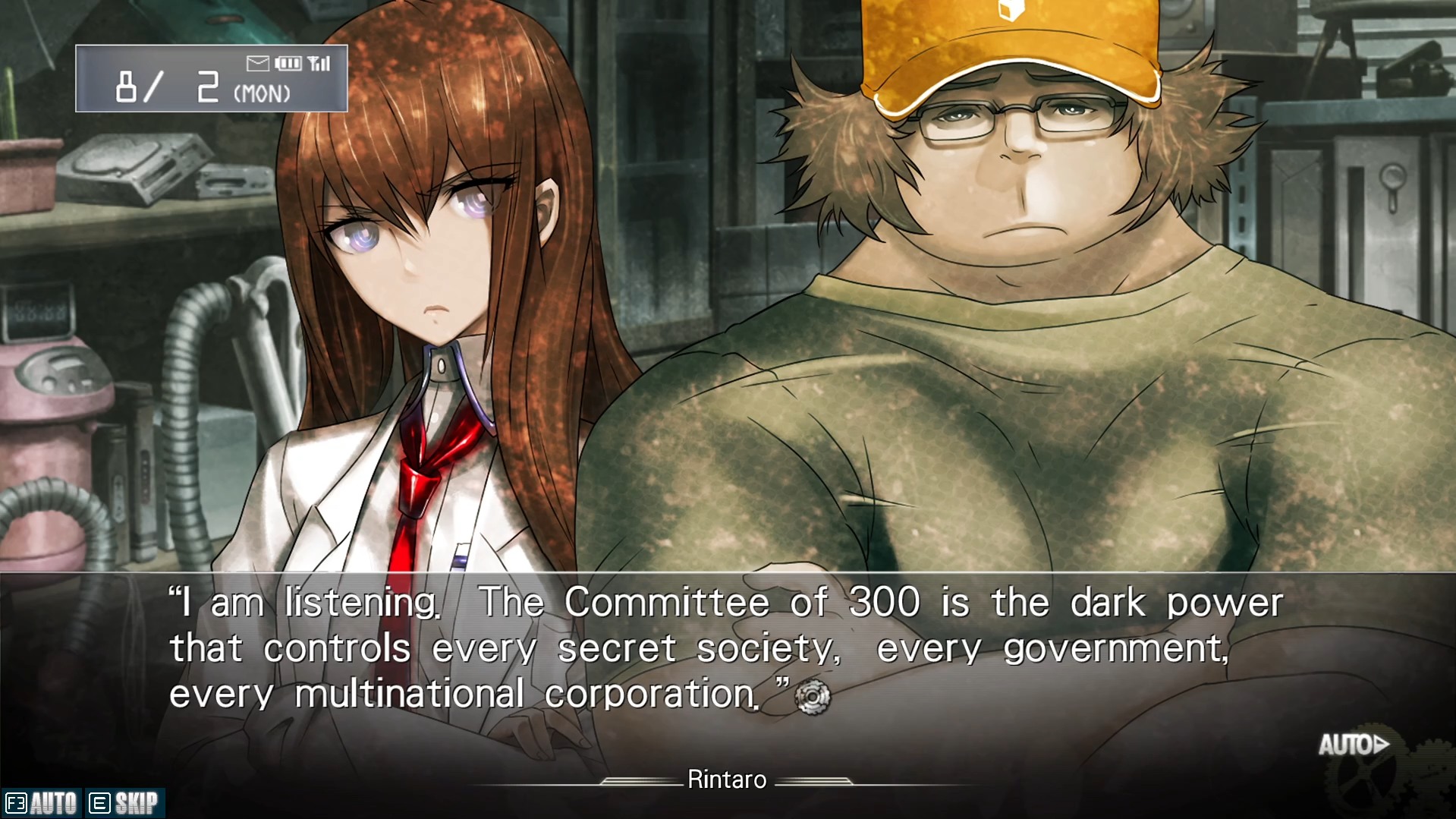
We, however, mostly never see the direct actions or members of the Committee in the series. They largely execute their plans through proxies, through various other organizations that are publicly visible. In Steins;Gate, the Committee works through SERN to monopolize time travel and create a dystopian future. In Chaos;Head, it pursues mind control and reality manipulation through NOZOMI.
Through front organizations, the Committee enacts human experimentation and large-scale projects involving mind control and reality manipulation. At the same time, it maintains control through propaganda, surveillance, and layered intermediaries without being noticed.
Even major incidents like the Shibuya Earthquake or world lines with dystopian futures are shown to be part of the group’s long-term plans. In some scenarios, the Committee ultimately achieves near-total control over humanity, whether through technology, global conflict, or world line manipulation.
The evolution of the “Committee of 300” is a fascinating example of how ideas change over time. What began as Walther Rathenau’s critique of economic elites was reinterpreted into a loose conspiracy theory and eventually reimagined as a central antagonist in the Science Adventure series.
In doing so, Science Adventure doesn’t just borrow from conspiracy culture, it refines it. By giving structure and internal logic to otherwise unsubstantiated ideas, the series transforms speculation into compelling storytelling. For fans exploring the series’s real-world inspirations, this journey reveals just how easily the line between reality and fiction can blur.




KKB Community
0 comments