As of today, it has been exactly ten years since the release of the Steins;Gate 0 visual novel, an unprecedented adaptation of existing Steins;Gate side material that served to expand upon the circumstances that made the ending of the original Steins;Gate possible—those being Arc Light of the Point at Infinity, the Epigraph light novel trilogy, as well as the ending of Annularly Chained Ouroboros. But after a decade, how well has Steins;Gate 0 aged? The answer is complicated.
Steins;Gate 0 is a project that emerged under turbulent circumstances. It was announced around the time of the cancellation of Steins;Gate’s planned sequel, the Committee of Antimatter, and Chaos;Child’s disastrous launch on the Xbox One—timing that I do not believe is coincidental. Did they cancel The Committee of Antimatter in favour of making Steins;Gate 0? Or did they make Steins;Gate 0 in part to make up for having to cancel The Committee of Antimatter? To this day, we do not know. But at the very least, the way many fans often perceive it, Steins;Gate 0 exists because MAGES. was desperate to recoup their losses after disastrously miscalculating the performance of the Xbox One. And considering just how well 0 sold—100,000 copies by day 1—it was truly a move that paid off, at least financially. But in turn, it forever changed the direction SciADV went in afterwards, marking a pivot towards further hyper-focusing on the Steins;Gate subseries.
Thus, within the embedded video and article below, I will go over what has aged well and what has aged poorly. Feel free to go through either version.
Disclaimer: The rest of this article contains spoilers for the Steins;Gate subseries.
Starting off with what I think has aged well: the concept of world line recursion and the narrative’s general design. The very basis of Steins;Gate 0 hinges around this idea of world lines recursively serving as messengers to one another down this metaphorical chain of countless world lines—something which ties into the main OST of the game: “Messenger”. This is a holdover from the ending of Ouroboros, which outlines how the only reason that Operation Skuld was able to be possible was because of the efforts of countless iterations of Okabe, whose memories were eventually accumulated by the Okabe who ultimately recorded the video D-Mail. He was the final messenger, but far from the only messenger. There were countless “dead zeroes”—hence the title Steins;Gate 0. Compared to the original Steins;Gate, which is a much more standard time travel story, I always found the idea of Steins;Gate 0’s narrative to be significantly more unique and thought-provoking. Unlike the original Steins;Gate where everything other than the true ending is little more than a what-if romance route, all the routes in Steins;Gate 0 are vital to the narrative, each contributing a piece to the puzzle necessary for the conception of Operation Skuld.

On top of the routes’ narrative contributions, I also find that a decade later, much of the content within those routes is still largely solid. They have incredibly high highs and a strong emotional core, regardless of whether they were adapted from prior material like Vega and Altair or completely original like Promised Rinascimento. Okabe in Steins;Gate 0, while not as strong of a character as he is in the Epigraph trilogy, is still much more compelling to me than he is in the original Steins;Gate. While you do end up losing the motif of the solitary observer by having multiple points of view, Okabe ends up having a much more prominent character arc. And while I do wish they were bold enough to make him as unrecognizable from his former self as they did in Arc Light and Epigraph, I still love the change Okabe undergoes over the course of the story of Steins;Gate 0.
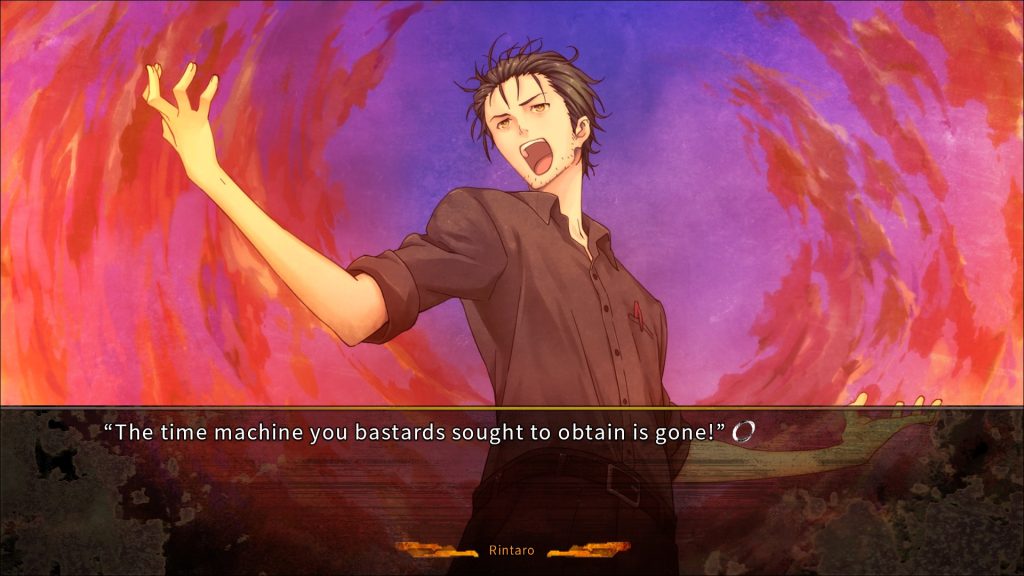
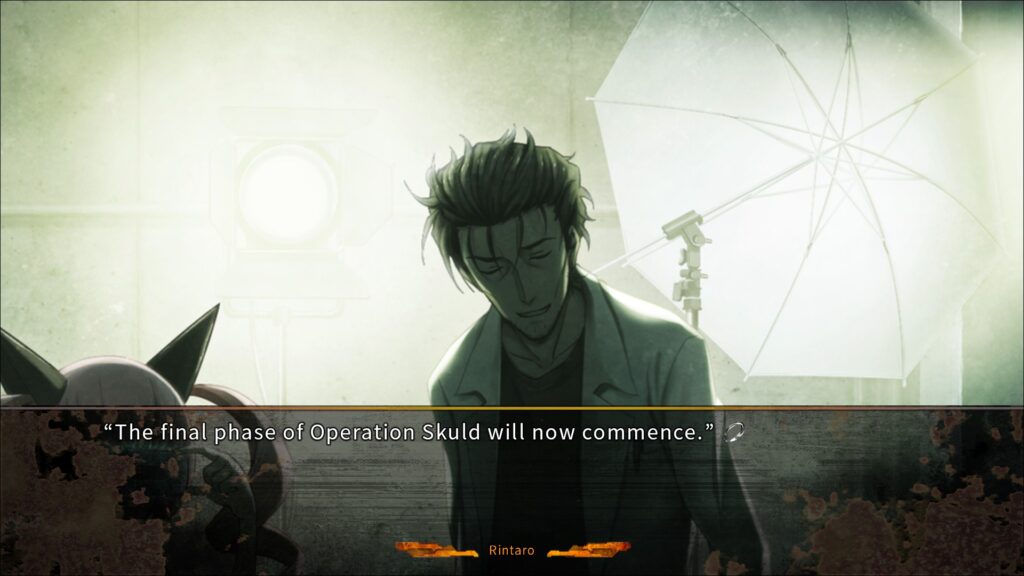
On note of the narrative design, let’s talk about the 0 anime—the other part of Steins;Gate 0 that I think has aged well. Steins;Gate 0’s narrative is very peculiar in that both mediums’ versions of the story are necessary to complete the tale. The visual novel shows the routes for five different world line iterations that happened at some point within the chain, although we do not know the exact order in which they occur. The anime, meanwhile, shows a route for the very final iteration of the story—the tale of the final Okabe who ultimately recorded the video D-mail for Operation Skuld. The ending of this final Okabe’s journey is shown for a mere 20 minutes in the 0 visual novel; the majority of it remained unseen until the 0 anime. In those respects, the 0 anime is more akin to a final route for the 0 visual novel as opposed to a conventional adaptation.
Considering the design of the game and the linearity that an anime is supposed to have, I think this was definitely the right decision. Instead of making an incomplete adaptation of an incomplete story, they made a complement that completed the story. And I still remember what it was like watching Steins;Gate 0 as it aired weekly back in the day. That was… an unbelievable experience. It answered so many questions I’d had not only from the 0 visual novel, but also from the side material it was based on. For longtime fans who’d been following the series since the original visual novel’s release, I can only imagine how it felt to get an answer to what happened to Mayuri, Suzuha, and Okabe after Arc Light. Just generally, the anime also made for a more coherent experience of Steins;Gate 0 by virtue of it being locked into the perspective of the final messenger. To this day, I still find that most ardent SciADV fans prefer the 0 anime to the 0 visual novel, myself included. Heck, I even prefer the 0 anime to the original anime even with the original’s significantly stronger direction and animation. After all, the 0 anime is the most useful SciADV anime to date because it isn’t just a watered-down version of its source material. It’s an essential part of the overall series narrative, even foreshadowing future installments like Anonymous;Code. And that to me, has aged incredibly well.
If there’s one last thing that I think has aged especially well for Steins;Gate 0, it’s the music, though I can say that about pretty much every SciADV entry. After all, Takeshi Abo never misses with his work. And the same was true for Steins;Gate 0. The visual novel has so many of my favourite tracks from SciADV, including the likes of Messenger, Re-Awake, Logical and more. And the 0 anime also has some outstanding tracks—like Okabe’s Defiance, Last Mission, and Mayuri’s Sadness. In terms of music, I think Steins;Gate 0 was overall an upgrade over the original Steins;Gate. So that to me is one element of it that has aged amazingly.
But now let’s move into what hasn’t aged well. First up is ironically the very thing I praise Steins;Gate 0 for—its design. As much as I adore the very concept of world line recursion, I think the execution of it left much to be desired—specifically in the sense of it often being too hard to wrap your head around or straight up just easy to miss for people lacking context. It’s understandable if someone who only goes through the 0 anime misses what world line recursion is because that itself only shows one iteration. But there’s also a lot of people out there who go through both the 0 visual novel and 0 anime, and yet still miss how the routes are related to one another—thereby also missing the point of the story. And I do not think this is so much a matter of media literacy, as it is just poor design on MAGES.’ part. World line recursion might be obvious to someone who has gone through the side material Steins;Gate 0 is based on. But this idea should have been made much more explicit within Steins;Gate 0 itself. And confusion surrounding that idea was made worse specifically because of bizarre choices the creators made in how they’ve portrayed world line recursion.
For instance, the game presents Milky-way Crossing immediately after Vega and Altair, almost making it seem like the former is a direct continuation of the latter even though it’s not. This is explicitly confirmed in the Amadeus Script guidebook, which states that there are countless recursive iterations that take place in between Vega and Altair and Milky-way Crossing. So Milky-way Crossing is not some random epilogue to Vega and Altair. And yet I still come across so many people who misunderstand this aspect about the series’ chronology. What the SciADV team should have done in-game was make a separate “True End” button on-screen like they did for so many other games in the series. That would have avoided this decade-long confusion.
Additionally, the D-RINE from Promised Rinascimento is another common point of confusion. For a long time, because of the way in which the series’ mechanics work, many hypothesized that the D-RINE to branch onto Milky-way Crossing was from an unseen iteration with a future presumably identical to that of the Vega and Altair route, even though the D-RINE’s contents were identical to what was sent in Promised Rinascimento. After all, world lines in Steins;Gate 0 work recursively. And how else could a D-RINE from Promised Rinascimento get sent to the past of the Vega and Altair route on a completely different world line with a completely different history? This aspect of the story seemingly being a contradiction is acknowledged on page 243 of the Amadeus Script guidebook. But the creators’ explanation for the phenomenon is also very vague and unclear, with them stating that they didn’t apply any logic toward which world line received the D-RINE, and that it worked the way that the Kurisu death D-Mail and the Operation Skuld video D-Mail worked. I’ve seen people interpret these comments as them either just letting there be a plot hole, or that the D-RINE operates by a world line targeting system very similar to how the encrypted nostalgia drive is sent for Operation Skuld. Whatever the case happened to be, this point needed to be made far more explicit in-game. The fact that this point is still discussed a decade after the game’s release is yet another aspect of it that just has not aged well.
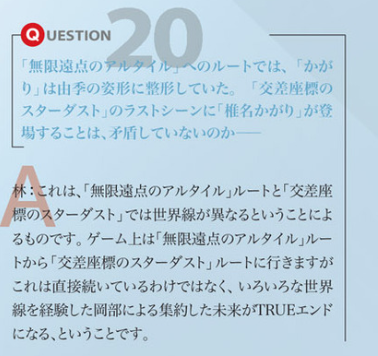
I think that one major contributor to the very existence of the aforementioned shortcomings was the game’s incredibly rushed development timeline. With how dire MAGES.’ circumstances were following the cancellation of the Committee of Antimatter and Chaos;Child being a commercial flop at launch, Steins;Gate 0 was forced out in a matter of mere months after its announcement. They needed to get their money back as soon as possible, hence why they chose to make something based off of existing side material. That helped substantially cut down the game’s development time. But even with much of the story having existed already, the development team still ended up having to cut corners. Page 237 of the Amadeus Script guidebook describes some plot elements that they wanted to write into the 0 visual novel that they simply were not able to. Some of these ended up being covered later on in the Steins;Gate 0 anime like how the 3000 time leaps worked. But content from the planned Fubuki route ended up having to be completely discarded and relegated into a drama CD. And like the cut content, I think the holes they’d left in the visual novel’s incomplete story were a result of the game’s rushed development.
That leads me into the next aspect about Steins;Gate 0 that I don’t think has aged well—tonal clashes. Presumably due to time constraints, there’s a good number of sprites and CGs within Steins;Gate 0 that are straight up reused from earlier Steins;Gate games despite being in completely different art styles. And while that’s definitely not a huge deal for a visual novel, a decade later, it’s still something I find a little jarring. Mayuri, for instance, looks completely different from scene to scene. And it feels so off. However, it’s not just artwork that I find clashing in tone. It’s also the constant juxtaposition of dark, depressing material with completely random fanservice. This happens way too many times throughout Steins;Gate 0. You have a very somber scene, only for it to be interrupted by completely random fanservice. It is true that Steins;Gate 0 is a SciADV side entry, very much like Robotics;Notes DaSH and the LCC games. So you shouldn’t go into it expecting the exact same kind of tone you would get out of a mainline. But still, I find these recurring tonal clashes simply have not aged well for the game.
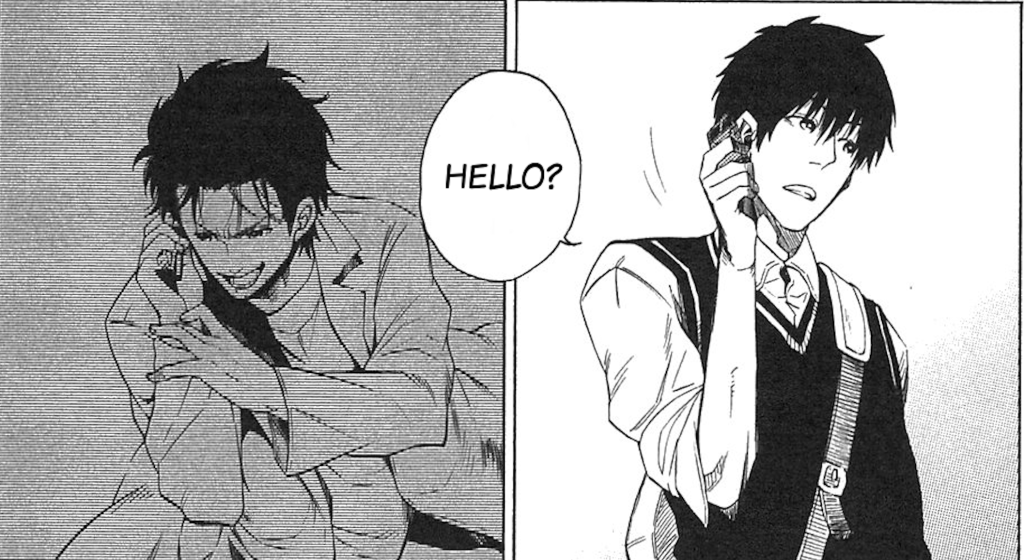
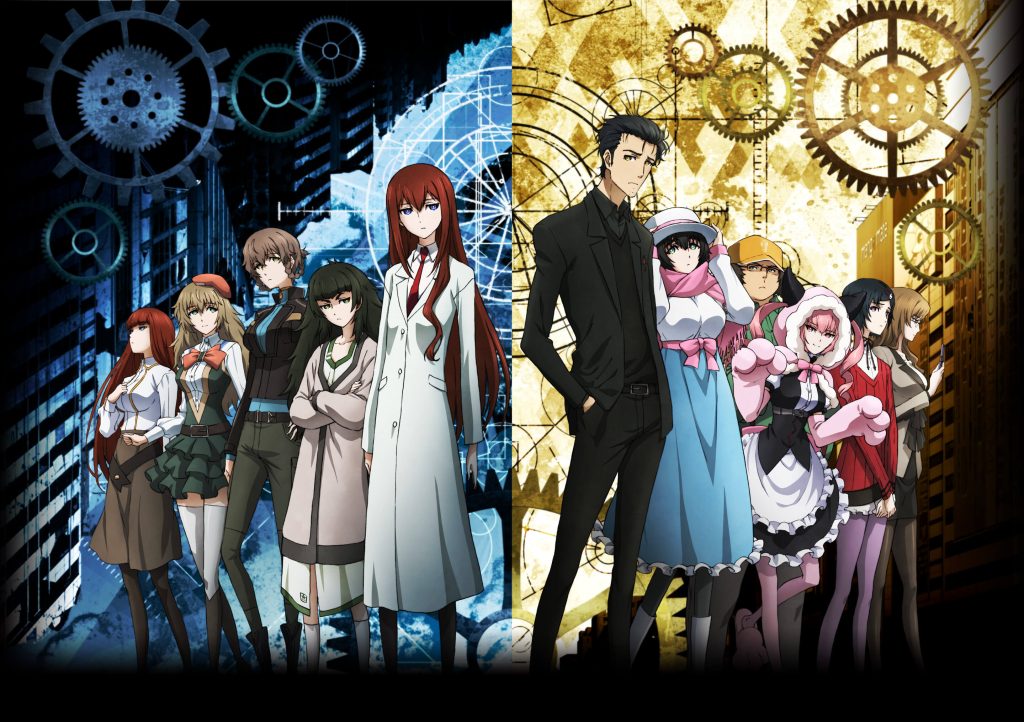
I guess if there’s one last thing about Steins;Gate 0 that I’d say hasn’t aged well, it’s changes in character designs. And no, I don’t mean things like Okabe’s neck looking odd in some CGs. I mean the fundamental change in appearances from previous renditions of Arc Light and Epigraph. For instance, let’s look at Okabe. The whole idea of Okabe’s design in prior Steins;Gate side material is that he’s supposed to be completely unrecognizable from who he was before—a shell of his former self. And in Steins;Gate 0, they changed him to look exactly like he does in the original, but in a black suit. I understand the brand recognition element behind doing this. You need consumers to recognize the protagonist of your cash cow. But from a thematic standpoint, I don’t like this change at all. For me, it takes away from some of the emotional core behind what Steins;Gate 0 was based on.
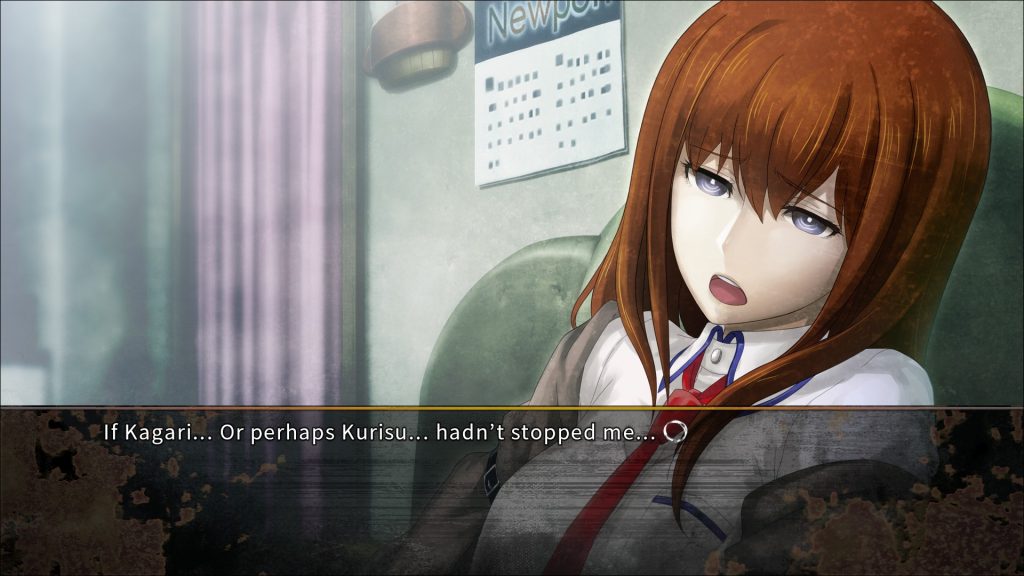
Another one of these problematic character design changes was with Kagari. Originally, in the Epigraph trilogy, there was never any of this nonsense about looking like Kurisu, because Kagari’s hair was red and Kurisu’s hair was chestnut-coloured—hence the “kuri” part of her name. But because the Steins;Gate anime had made Kurisu’s hair red instead, fans commented at the time of the Epigraph trilogy’s release that Kagari and Kurisu looked quite similar to one another. As per page 238 of the Amadeus Script guidebook, the writing team decided to play upon these fan comments and legitimately write a resemblance plot line in Steins;Gate 0. I personally don’t think it’s the worst plot line in the world. It does tie in to an extent with series-wide themes. But I do think that Kagari might have been a more interesting character in Steins;Gate 0 had they just… not deliberately made her into a Kurisu look-alike. At the very least, we wouldn’t constantly have had all these crazy clone theories on Reddit. Honestly, I think one thing that would have made Kagari’s character more interesting was if they had confirmed her biological parents were… a certain duo from Robotics;Notes. But even with what’s been presented in Steins;Gate 0 alone, that’s ironically a plausible theory. I just wish there was more of it to go off of so it wouldn’t just be headcanon.
All in all, the confusing structure-related choices, tonal clashes, and character design changes don’t outright ruin Steins;Gate 0 for me. But I do think they contributed to holding it back from what could have been something better. Though that just about encapsulates what I think hasn’t aged well about Steins;Gate 0.
So overall, how has Steins;Gate 0 aged in the span of a decade? I know I wrote at length about my criticisms for it, but I’d say that all in all, it’s still a fascinating, heart-filled part of the SciADV storyline. It made for a far more accessible version of the content depicted in some of the most important pieces of Steins;Gate side material. Fans often complain that Steins;Gate 0 is just a worse version of the side material it adapted. And to be fair, I do agree with that sentiment to an extent. But as such, if there’s any game that could use a remake in the SciADV franchise, I think it’s Steins;Gate 0. After all, the way it stands, people need to go through both the 0 visual novel and 0 anime at the very least. Heck, for people to have complete understanding, then that requires the side material Steins;Gate 0 is based off of as well. I think it would be nice to have one definitive version of Steins;Gate 0 combining all of that content in one package. They announced Steins;Gate 0 Elite almost six years ago. But considering the steep costs of that, who knows if that’s ever happening? Looking at recent comments concerning Steins;Gate RE:BOOT, it seems as though the team is moving away from fully animated ADV games due to cost and workload. But with them seemingly making Steins;Gate RE:BOOT to facilitate future series development, I wouldn’t be surprised if one day… we see a Steins;Gate 0 Re:Boot. And that to me would have potential to make a truly definitive version of Steins;Gate 0. I hope that one day, we’ll see it come to fruition.
Thank you for reading. Until next time!

KKB Community
0 comments