Despite its popularity and reception, a lot of fans are unaware of the circumstances that led to Steins;Gate 0’s creation, as well as why it exists. On the surface level, most understand Steins;Gate 0 as a visual novel and anime that acts as an interquel to the original story, serving to expand upon its true ending. And while this is true, there’s much more to what this entry in the series is and why it’s a thing to begin with. After all, contrary to popular belief, Steins;Gate 0 mostly wasn’t an original story—it was an adaptation of existing supplementary content. Given the fact that its source material already existed, why did MAGES. make Steins;Gate 0? In this article and video, I want to go over its development history and the circumstances that led to its creation. Feel free to either watch the embedded video or read the article below.
Disclaimer: The rest of this article contains spoilers for the Steins;Gate subseries.
After 5pb. and Nitroplus released the original Steins;Gate in October 2009, they followed up on it with several pieces of supplementary media over the course of the next few years. A common topic these stories touched upon was the circumstances behind what made Operation Skuld possible. And there are three particular pieces of side material that I would like to go over: Arc Light of the Point at Infinity, the Epigraph trilogy, and Annularly Chained Ouroboros.
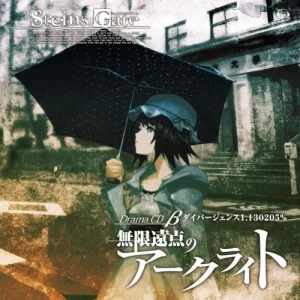
Arc Light of the Point at Infinity was the second part in a trilogy of drama CDs released just a few months after the original visual novel; it was an incredibly heartfelt, emotional companion story to the game’s true ending that focused on Mayuri. It took place in the Beta attractor field, in a world where Okabe failed to save Makise Kurisu and did not return to July 28 a second time, serving to expand upon Chapter 11 of the visual novel and explain why Mayuri slapped Okabe—something that many thought was a little bit out of character.

Arc Light of the Point at Infinity would then go on to inspire the Epigraph trilogy, a series of light novels released between 2012 and 2013 that were designed as a lead-in to the story of Arc Light as well as the series’ third mainline entry, Robotics;Notes, which was also releasing around that time. The trilogy consisted of Epigraph of the Closed Curve, Pandora of Eternal Return, and Altair of the Point at Infinity. Just like Arc Light, these light novels also followed an Okabe in the Beta attractor field who’d failed to save Kurisu and lived on. But in contrast to Arc Light, Epigraph had a significantly larger scope, featuring a new focus on artificial intelligence and a number of brand-new characters, the most significant of whom were Hiyajo Maho, Shiina Kagari, and Alexis Leskinen, who would make appearances in other Steins;Gate material that released around the same time.

Annularly Chained Ouroboros, lastly, was a two-volume-long novelization of Steins;Gate that released between 2010 to 2011, serving as an alternate retelling of the original story. It followed the same general plot as the visual novel, but it featured many little story additions and other minor differences along the way—not least of which being the introduction of all sorts of new mechanics to the series. One of these, as you may know, is “world line superposition,” a concept that would later become important to future series installments.
But the most critical of the many concepts Ouroboros explored was “world line recursion.” Ouroboros’s ending features an extended version of the Operation Skuld video D-Mail, or Nostalgia Drive, wherein Future Okabe further details how he was able to send it. Specifically, he highlights that this video D-mail he sent was the culmination of the efforts of countless iterations of Okabe—or “dead zeroes,” as he refers to them—each of whom served as messengers to one another down this near infinitely long chain of world lines. One Okabe served as a messenger to another, who served as a messenger to yet another, and so on and so forth. The Okabe recording the video D-mail served as the final messenger along this chain, having accumulated the memories of and lessons learned by all these prior iterations.
Evidently, these three aforementioned pieces of side material ultimately expanded extensively upon the ending of the original game—to the point that they could legitimately have turned that content into a full-fledged visual novel of its own if they’d wanted to. But while this supplementary media did ultimately form the basis for Steins;Gate 0, at this point in time, that wasn’t a plan they were particularly keen on. The year after Altair of the Point at Infinity released, series staff were instead planning on releasing a light novel sequel to Steins;Gate called “The Committee of Antimatter,” set to take place six years after the original game’s true ending and release in close proximity with Chaos;Child’s own launch. But Antimatter was ultimately canceled—with no explanation—just a few weeks prior to its planned release and just a few days after Chaos;Child was released on Xbox One. The ultimate reason Steins;Gate 0 exists is, seemingly, a direct result of the fallout from Chaos;Child’s lackluster launch and likely also the Committee of Antimatter’s cancellation.

Chaos;Child, the fourth mainline entry in the SciADV series, was set to be an Xbox One–exclusive title whose release was intended to coincide with the console’s Japanese launch. And while Chaos;Head NoAH, Steins;Gate, and Robotics;Notes all initially released on the Xbox 360 and sold well, the same could not be said for Chaos;Child on the Xbox One. After all, the 360 had performed solidly in Japan, but as per Famitsu’s estimates, the Xbox One only sold a measly 115,000 units in its lifetime. In the end, Chaos;Child, despite being the longest and most expensive SciADV to produce up until that point, sold just 1,415 physical copies in its launch week, less than 2% of what the previous mainline entry, Robotics;Notes, had sold during its launch week. The game’s disturbingly poor sales seemingly had immediate consequences on both MAGES. and SciADV as a whole.
On top of porting Chaos;Child to PlayStation platforms for obvious reasons, the company immediately pivoted back into working on a high-profile project within the Steins;Gate subseries, which, thanks to the ever-so-successful Steins;Gate anime adaptation, was their unabashed cash cow. The easiest, quickest, and most profitable thing to produce was a sequel game to the original Steins;Gate based on existing side material. So within days of Chaos;Child’s less-than-ideal Xbox launch, MAGES. announced they were canceling Steins;Gate: The Committee of Antimatter. Then, within three months of its cancellation, MAGES. went on to announce Steins;Gate 0 in its place, which would release at the end of 2015—less than a year after Chaos;Child.

Nobody outside of those involved in the project truly knows why MAGES. opted to cancel Antimatter, but based on the surrounding circumstances, I firmly believe the light novel’s cancellation and the subsequent announcement of Steins;Gate 0 were fundamentally interconnected. Perhaps the developer announced Steins;Gate 0 in part to make it up to consumers for the cancellation of the Committee of Antimatter. Or perhaps they canceled the Committee of Antimatter because they wanted to make Steins;Gate 0 instead. After all, Steins;Gate 0 would have been a much more popular, marketable, and profitable sequel by virtue of it being a full-length game and anime—as opposed to a one-off light novel volume. Though of course, then you would have to explain why MAGES. couldn’t have done both projects when Antimatter was already right near the finish line. I discuss more of the circumstances behind Antimatter’s cancellation in my video on the topic from last year; there may have been a number of other factors at play, such as potential narrative and lore issues, as well as staff and company disagreements.
But whatever the case may be, I do not believe the timing of Antimatter’s cancellation and Steins;Gate 0’s subsequent announcement is a coincidence. The way I see it, the financial pressure MAGES. was under from Chaos;Child’s botched launch most definitely played a heavy role in Steins;Gate 0’s conception and possibly also Antimatter’s cancellation. The former point was corroborated by series creator Chiyomaru Shikura at the time of Steins;???’s announcement in October 2020. He alluded to the impact Chaos;Child’s commercial disappointment had on MAGES. as a company and outlined how it ultimately led to the conception of the then-announced Steins;Gate thematic sequel. If Chaos;Child’s commercial underperformance led to the idea of Steins;???, then it would seem likely, to some at the very least, that it also heavily contributed to the idea of and desire to make Steins;Gate 0 as well.
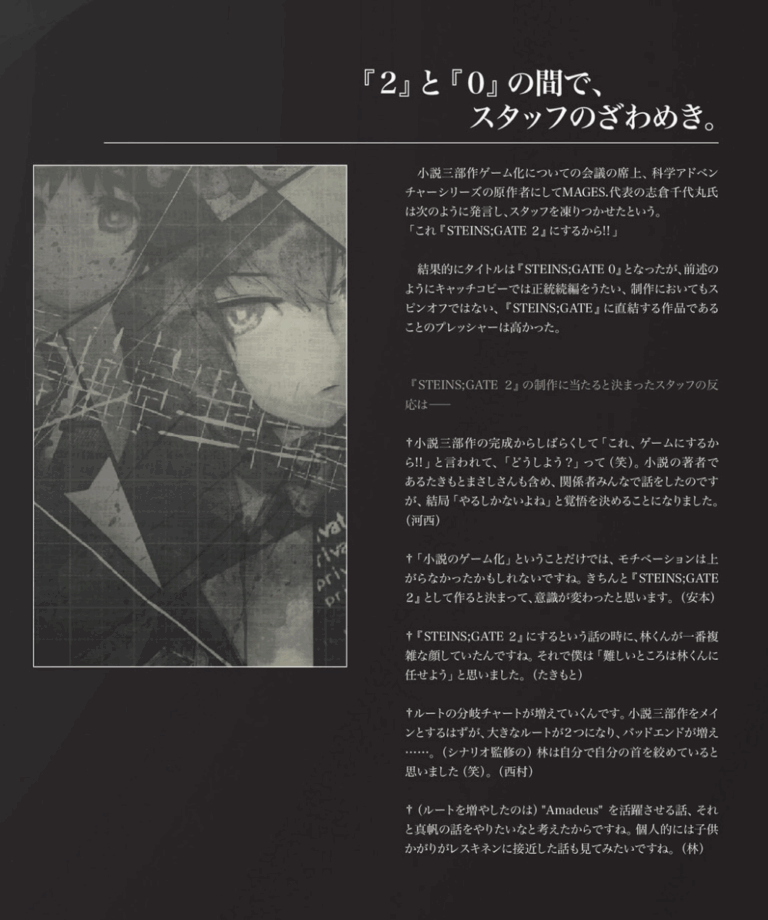
Additionally, the Steins;Gate 0 Amadeus Script guidebook also features commentary from series staff wherein they detail the conception of Steins;Gate 0. They outline how they were originally not particularly eager about the prospect of needlessly turning the novel trilogy into a game—but all of a sudden, in a meeting with series writers, Shikura proposed expanding the Epigraph trilogy into a “Steins;Gate 2” in visual novel form. And at that point, upon internal deliberations within the company, MAGES. concluded they had no choice but to make what would become Steins;Gate 0. Why did they have no choice? Perhaps because it was too good of a commercial opportunity to pass up given their imminent circumstances with Chaos;Child.
So in the end, the way many fans perceive it, the primary reason Steins;Gate 0 exists appears to be financial desperation and company circumstances at the time. MAGES. needed money, and they needed it fast. That’s why they designed a Steins;Gate sequel that was based on existing material. That way, they were able to release it within mere months of its announcement and quickly recoup their losses from Chaos;Child’s launch. This is not at all to say that Steins;Gate 0 is bad, or that its content isn’t important. It’s very important in a number of ways, especially to the SciADV content that released after it. But given that much of its content already existed beforehand, and given the company’s circumstances at the time, it is nonetheless often regarded as an IP that was formed due to financial desperation.
On that note, despite being based off of existing content, Steins;Gate 0’s development was still very much rushed—to the point that the game released somewhat unfinished. Time constraints meant the developers needed to cut out entire portions of the game from the final version of the story—the biggest cut of all being the Fubuki route, whose plot centered around Amadeus repeatedly cloning itself and hacking into Fubuki’s brain. Instead of incorporating the full route into the game, the company instead reworked bits of its premise into a drama CD titled Paradise Lost in Adaptive Radiation, which served as a continuation of the game—seemingly its Vega and Altair route in particular. In the visual novel itself, MAGES. also ended up having to reuse assets from previous Steins;Gate entries despite clashes in art styles. They simply did not have the time to do more over the course of the visual novel’s very short development period. Yet in spite of these issues, the Steins;Gate 0 visual novel was a resounding commercial and critical success—it sold a whopping 100,000 copies on day one.

Next up for the IP was the Steins;Gate 0 anime, where the involved parties faced the hurdle of adapting a nonlinear visual novel, which itself was an adaptation of existing material—an adaptation of an adaptation, if you will. At first, they explored the possibility of doing the 0 anime as a conventional adaptation, wherein they would cover the Promised Rinascimento route in one cour, then the Vega and Altair route in the second. But it became clear to them that an incomplete adaptation of an already incomplete visual novel would be neither appropriate nor very useful for an anime. We later saw this in practice through the 0 manga adaptation, after all, which was a conventional adaptation of the aforementioned routes serialized between 2017 and 2021. While it was a solid adaptation of Promised Rinascimento and Vega and Altair, all it made for was a nice and quick way to reexperience two parts of the visual novel—far from being able to serve as a replacement due to its missing content, and far from being a meaningful complement due to not adding much to the game’s narrative.
What they decided to do instead with the anime was not create a conventional adaptation at all; rather, they would make something more akin to a sequel, or final route to the visual novel, vis-à-vis world line recursion. The anime depicted the story of the very last iteration of Okabe, who ultimately went on to send the video D-mail, rather than a combination of any of the five prior iterations seen in the visual novel’s routes. And in doing so, the anime effectively completed the overall story of Steins;Gate 0, establishing the missing links in its narrative. It was still an adaptation of the Steins;Gate 0 visual novel (and Arc Light and Epigraph, technically), but it was nonetheless also a sequel, made possible via the concept of world line recursion.
However, producing the anime adaptation was no small task; a pretty large part of the scenario needed to be created from scratch, meaning the anime took a fair bit longer to develop. So while Steins;Gate 0’s visual novel released in December 2015, the anime only started airing in April 2018—a seven-year gap between the original anime and the 0 anime. Yet while the wait was long, the results were solid, and the anime was very positively received overall.
Coinciding with the release of the Steins;Gate 0 anime, MAGES. also launched Steins;Gate Elite, a fully animated remake of the Steins;Gate visual novel that used the original visual novel’s text as a base but incorporated the anime’s visuals instead of the original 2D sprites and backgrounds. Naturally, from that point onward, many wondered if a potential Steins;Gate 0 Elite would even be doable given all the differences between the visual novel and anime.
But lo and behold, shortly after the Steins;Gate 0 anime finished airing, MAGES. indeed went on to outright announce Steins;Gate 0 Elite, a fully animated remake of the Steins;Gate 0 visual novel—albeit, conflicting information arose regarding whether it would adapt the anime’s “final” route in visual novel form, or the visual novel’s routes but in animated visual novel style. Nonetheless, it has been more than five years since this announcement… and we have yet to hear much word on the status of 0 Elite. Will they do more with the Steins;Gate 0 IP? We’ll just have to see.
But that is more or less the gist of Steins;Gate 0’s development history. Contrary to popular belief, Steins;Gate 0 is not an original story. Rather, the visual novel is largely an adaptation of existing Steins;Gate side material that explored the circumstances behind Operation Skuld. Meanwhile, the Steins;Gate 0 anime acts as the final iteration of the Steins;Gate 0 storyline, functionally serving as a sequel to the Steins;Gate 0 visual novel rather than a conventional adaptation of it due to world line recursion. And the way much of the fandom sees it, the primary reason Steins;Gate 0 exists at all is largely because of MAGES.’ financial desperation in the aftermath of Chaos;Child’s Xbox One launch.

KKB Community
0 comments