Visual novels, more than any other kind of video game, are made or broken by their stories. Their localizations are inextricable from this; a good story is diminished by a translation that fails to live up to its ambition.
As a localization editor with prior experience in the field, it’s always disappointing to see a visual novel receive a subpar or outright disastrous English release. What’s even more disheartening is when it happens to a visual novel developed by the company this website focuses on—MAGES.
The CEO and president of MAGES., Makoto Asada, recently discussed his desire to release the upcoming remake of the first Memories Off game in the West. As a huge fan myself, the prospect of an English localization sparks a lot of personal excitement—but also a fair amount of concern.
My favorite visual novel, and why I’m worried
It might sound odd coming from a longtime writer on this particular website, but my favorite visual novel is Memories Off.
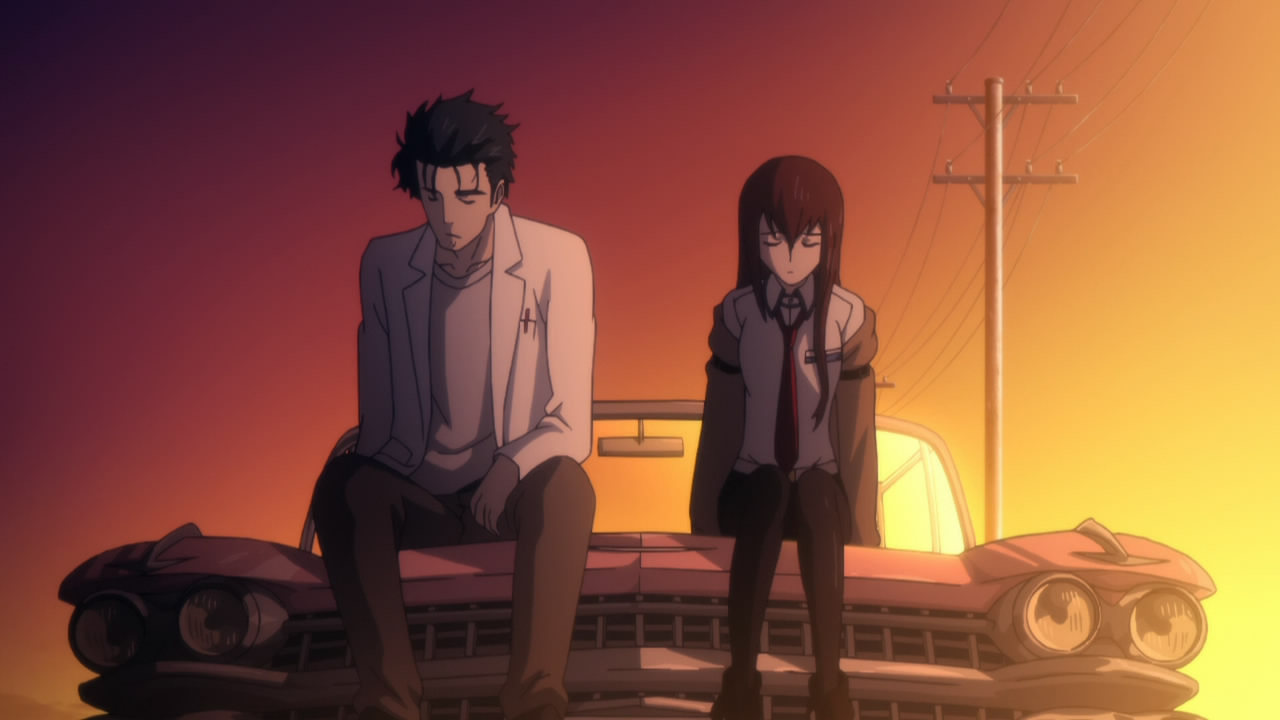
To be fair, I’ve always favored the emotional, character-driven side of SciADV. I couldn’t help but fall in love with the casts of Steins;Gate, Robotics;Notes, Chaos;Head, and all the rest. Okabe and Kurisu’s banter always got a laugh out of me, it was heartwarming to see Akiho and Kaito gradually reaffirm their soul-deep bond and face down overwhelming odds together, and there was something deeply satisfying about watching Takumi finally embrace his flaws and grow into the truest version of himself. I value strong character writing so much that my favorite part of Chaos;Child isn’t the game itself—it’s the nearly plotless but deeply character-rooted epilogue novel, Children’s Revive.
The Memories Off series—and especially its first entry, the focus here—is the quintessential character-drama affair. It might sound like blasphemy around these parts, but I would even argue it surpasses Science Adventure in that regard. But then, why not? Memories Off rarely focuses on anything but character-focused plotlines. The series lives or dies by its casts, and more often than not, it lives—and thrives.
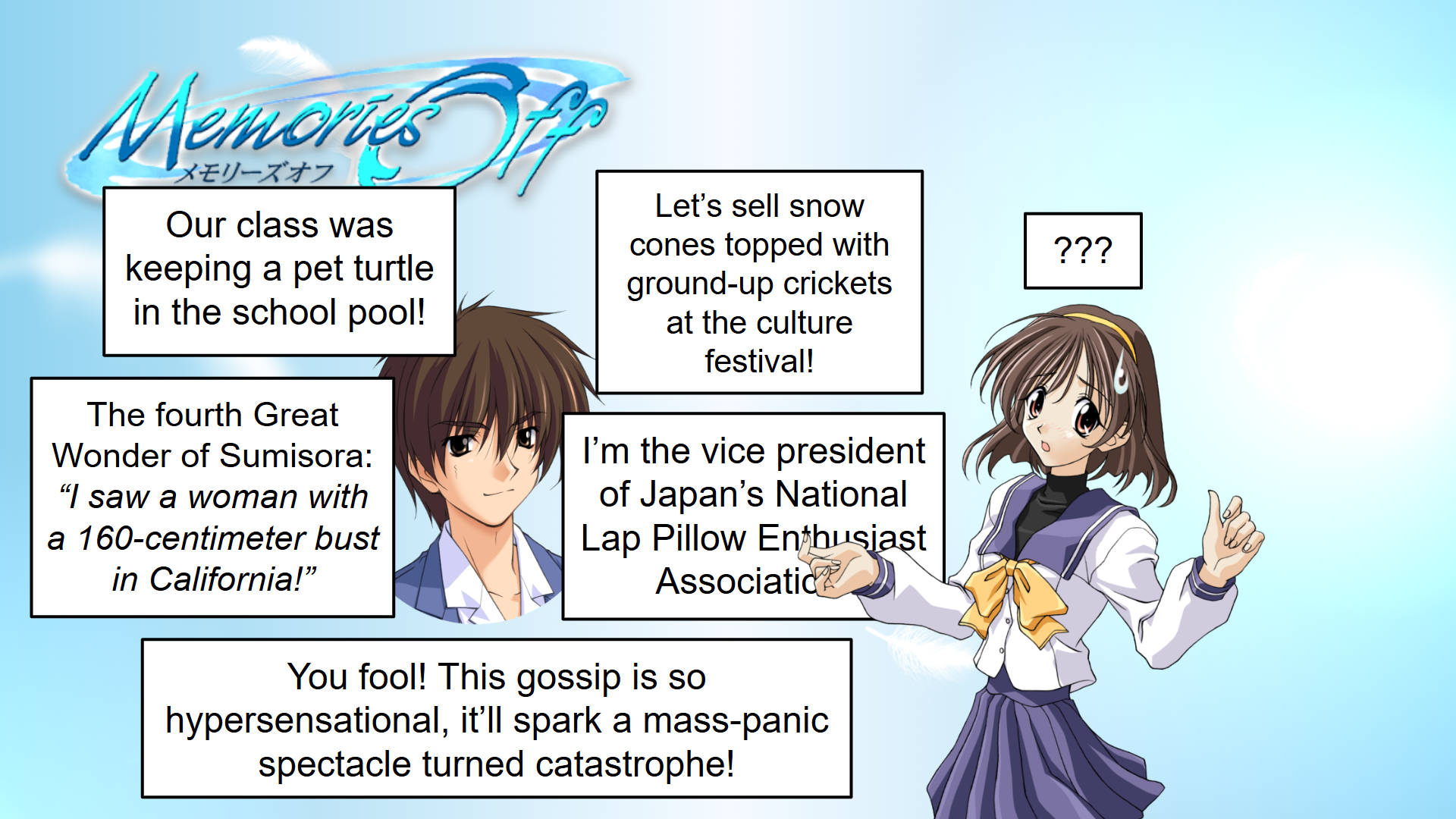
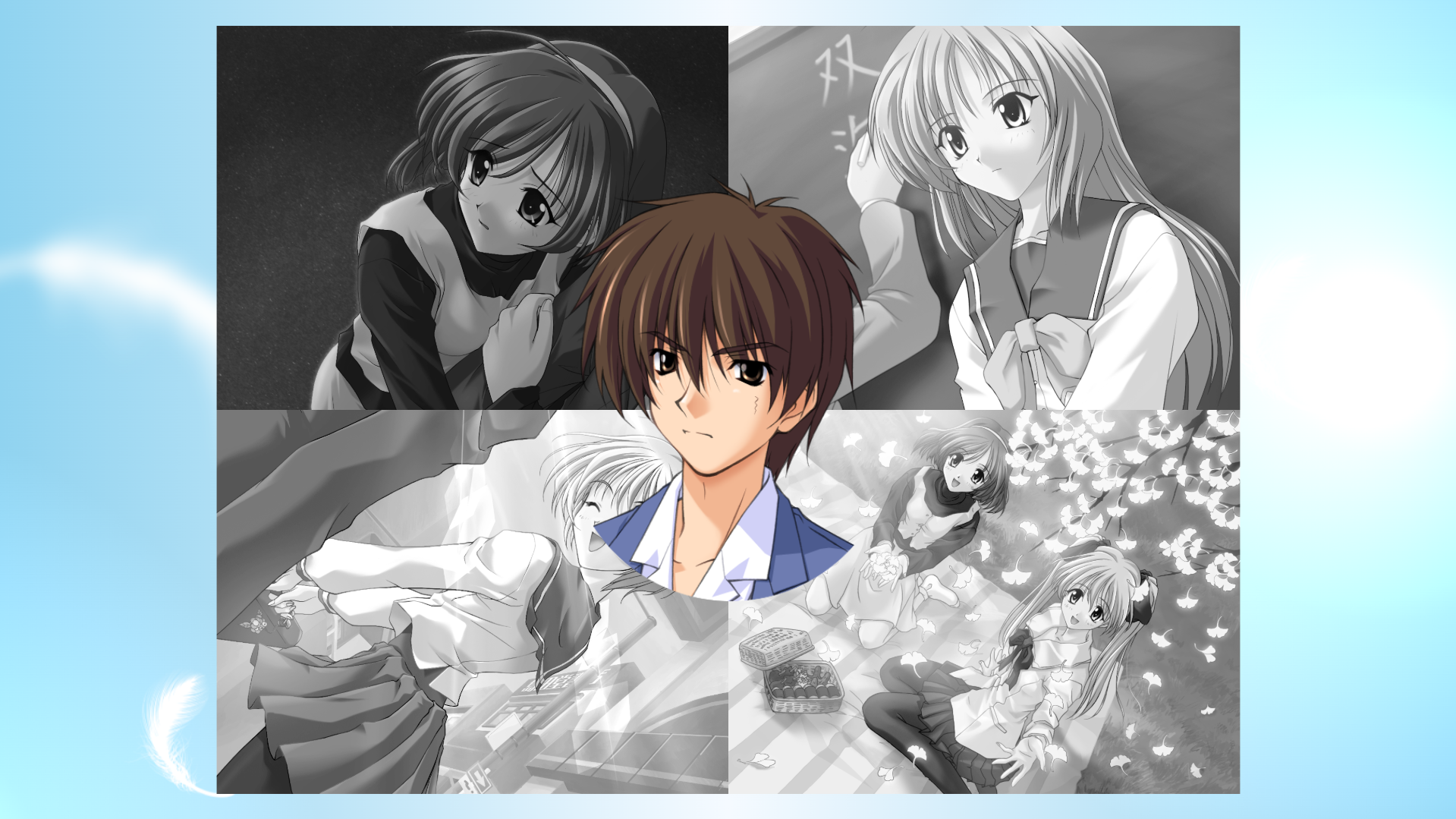
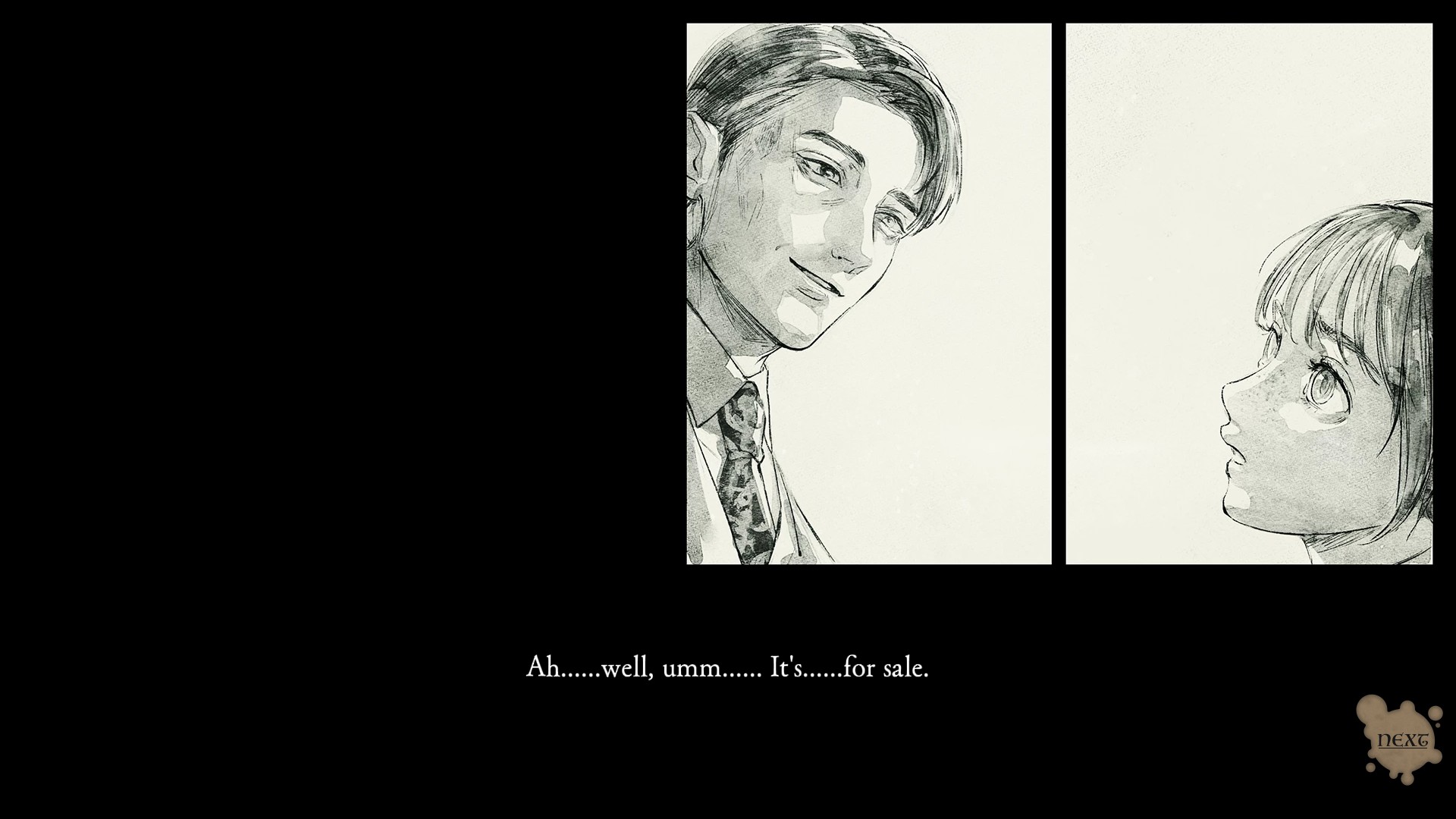
The first Memories Off entry follows Tomoya Mikami, a charming high school prankster with an… unorthodox sense of humor. Each day is a new opportunity to lead on his childhood friend Yue with an absurd tall tale, revel in nonsensical banter with his eccentric but strangely reliable best friend Shin, and generally live out a hectic-yet-peaceful student life most would agree is captivatingly nostalgic.
But as the chill of autumn begins to set in, slowly, Tomoya’s world sinks into a subtle melancholy that’s felt in the game’s music choice, background colors, and tone of narration. What Tomoya doesn’t often bring up—or rather, tries to suppress—is the void in his life left behind by lost love. Ayaka, his other childhood friend, passed away a handful of years before the story of Memories Off begins. In her absence, Tomoya desperately grasps at life’s small joys while he tries to escape the shadow of depression that tails him.
I won’t pretend Memories Off is perfect, or even close. But its emotional highs are so gratifying that, at least for me, it easily rivals Science Adventure’s best. I first completed Memories Off in 2024, at a time that felt to me like a severe SciADV content drought. The Memories Off franchise had the perfect opportunity to grab me—and grab me it did. I went on to launch #MemoriesOffMonday, hoping to draw Western attention to the games through fun facts and SciADV connections. When the ninth mainline entry, Memories Off Sousou, launched in summer 2025, I imported the pricey ultra-limited edition and booked my first flight to Japan to attend the exclusive concert event.
Memories Off means a lot to me, basically, which is why Makoto Asada’s recent comments are a big deal to me. An English release of the remake would mean I’ll finally be able to introduce the game that made a massive impact on me to my friends, the readers of this site, and the wider SciADV fanbase (who I feel will find a surprising amount to love about it).
At the same time, though, my skepticism isn’t allowing me to fully give in to my excitement. I have faith in the Memories Off team’s ability to develop a high-quality remake of the series’s inaugural entry—but I don’t have faith in MAGES.’ ability to deliver a high-quality English localization given its deeply checkered history with them.
Case Study: SINce Memories
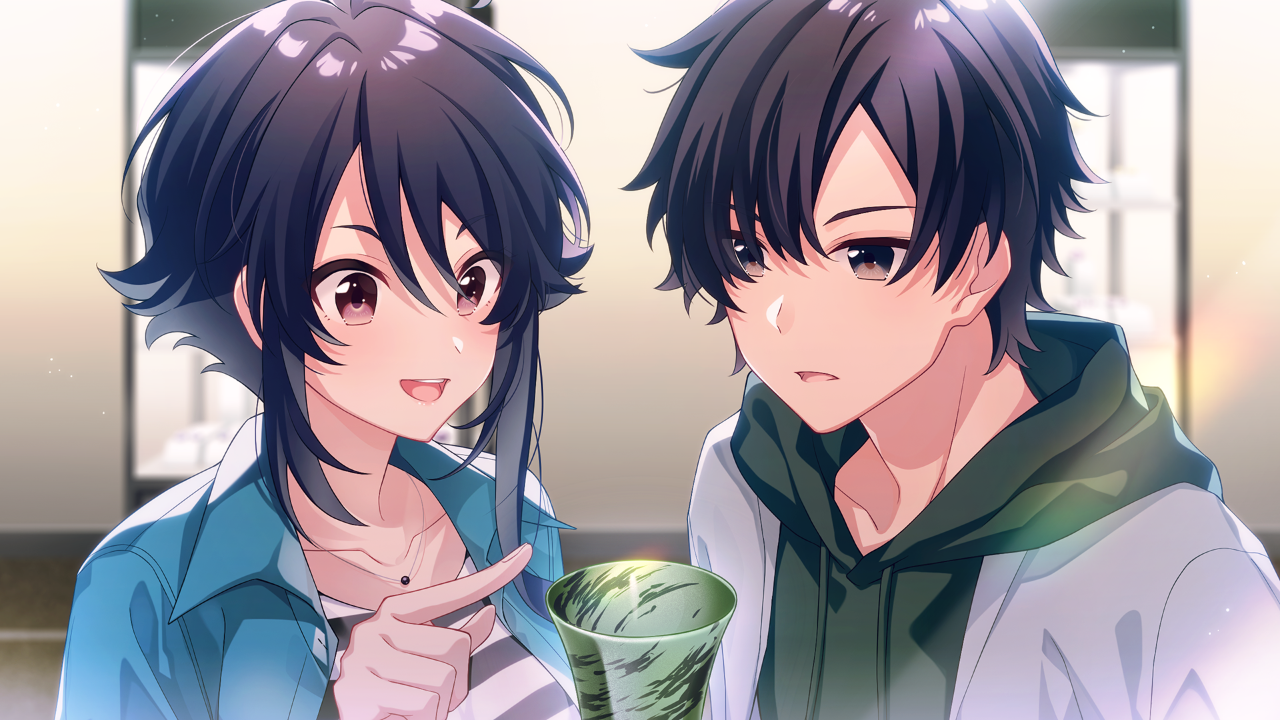
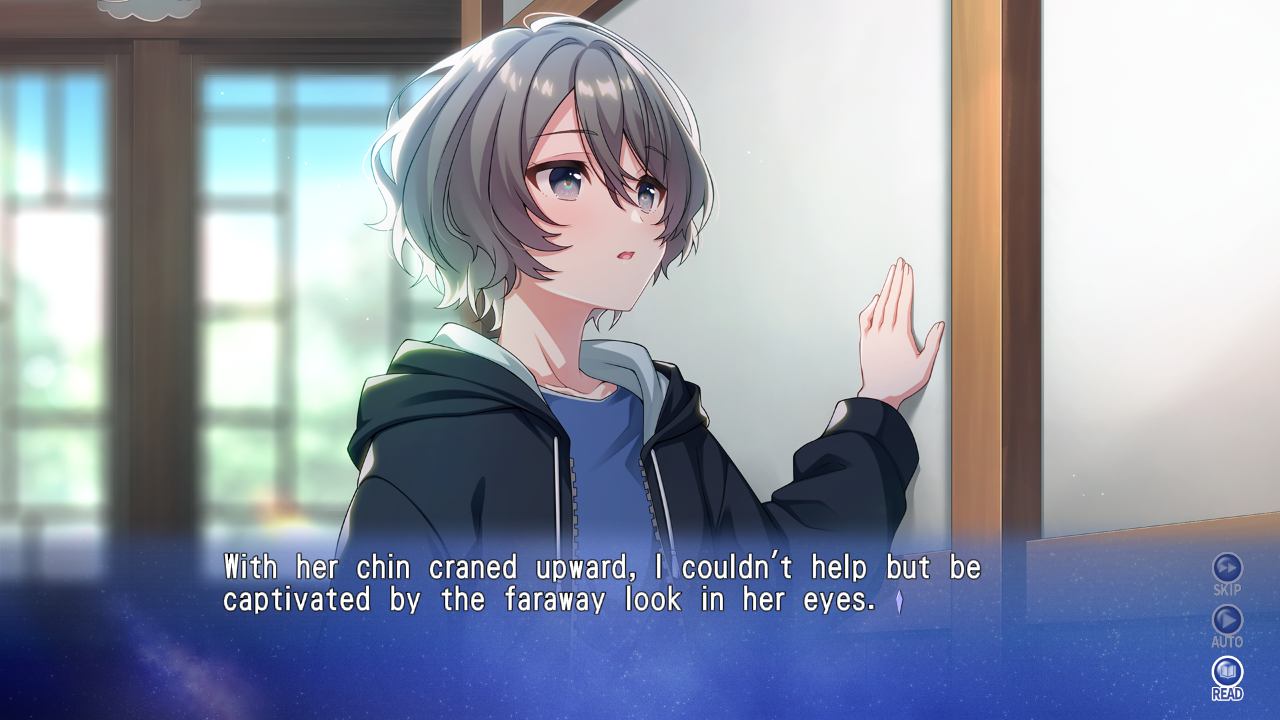
SINce Memories: Off the Starry Sky was technically the West’s first taste of what the Memories Off series has to offer. I say “technically” because MAGES. doesn’t actually consider it part of the series, a more complicated topic I discussed in another article.
At any rate, SINce Memories shares the same world and storytelling formula as the other Memories Off entries. By all accounts, it should have been a decent entry point: new fans needed a frictionless way into a series they’d never been able to try before, and while SINce Memories wasn’t the perfect candidate for that, it could have done the job well enough. The real barrier to success here was its corner-cutting English localization, which practically wore its mistakes on its sleeve.
I was initially decently satisfied with the localization in my 2024 review, arguing the English translation wasn’t all too bad, only leaving “something to be desired.” Clever wordplay adaptation—“I’m lovesessed!”—and down-to-earth dialogue writing made for a fairly well-defined reflection of the series’s tone in a new language. To the developer and publisher’s credit, the translator and editor brought on board for SINce Memories were recognized names in the localization sphere, having previously contributed to popular English releases like Kinkoi, Bokuten, and Aokana. The result was that SINce Memories was an enjoyable read for most of its runtime, and its translation was inspired enough that you could tell the team hadn’t just slapped it together and turned it in.
The biggest issue the English release faced was an onslaught of typos. These errors were frequent, obvious, and baffling; in the absence of information about the localization process, I can only infer that the translation faced a brutal deadline and badly lacking quality assurance.
SINce Memories has its fair share of comedic moments, of course, but with frequent bizarre typos like “my old man spud around on his heel” or “we decided to have a smell celebration on the final day,” tragically, you’ll often find yourself laughing for all the wrong reasons. Between this and some noticeable basic mistranslations—perhaps further evidence of an uncharitable deadline—it’s hard to say that the spirit of Memories Off came through as well as it should have.
The localization problems grow in intensity toward the end of the game—a point I didn’t highlight in my initial review, having not fully beaten it at that point. The prose becomes stiffer, and the typos crop up much more frequently. I found it became increasingly difficult to continue reading as the inadequacy of the English script grew increasingly grating. When I finally threw up my hands and swapped to Japanese in the final route, it was like taking a breath of fresh air. Here was the Memories Off flavor I was used to seeing in the writing, free from a barrage of basic errors. The contrast was tangible. I remember worrying that SINce Memories players, sore from this experience, might never give another Memories Off game a try if localized.
Case Study: Never7
SINce Memories’s localization may have been troubled, but it would be an exaggeration to call it the worst-case scenario. That label is better applied to titles like Never7: The End of Infinity.
Never7 is a character drama blended with a healthy dose of sci-fi. It’s the second visual novel Kotarou Uchikoshi, of Hundred Line and Zero Escape fame, ever wrote for, representing his earliest foray into the science fiction genre.
You might be asking what Never7 could possibly have to do with Memories Off. Good question: Memories Off was the first visual novel Uchikoshi wrote for. Never7, released half a year later, was something of a response to his first work, sharing much of its character-focused DNA. The wider series Never7 belongs to, Infinity, can therefore be considered something of a sister series.
Never7 received its first English localization in early 2025 when it was remastered for modern platforms. By all accounts, this release should have been a win-win for both MAGES. and its sci-fi visual novel fans, who were already heavily invested in the thematically similar Science Adventure series.
So… what happened?
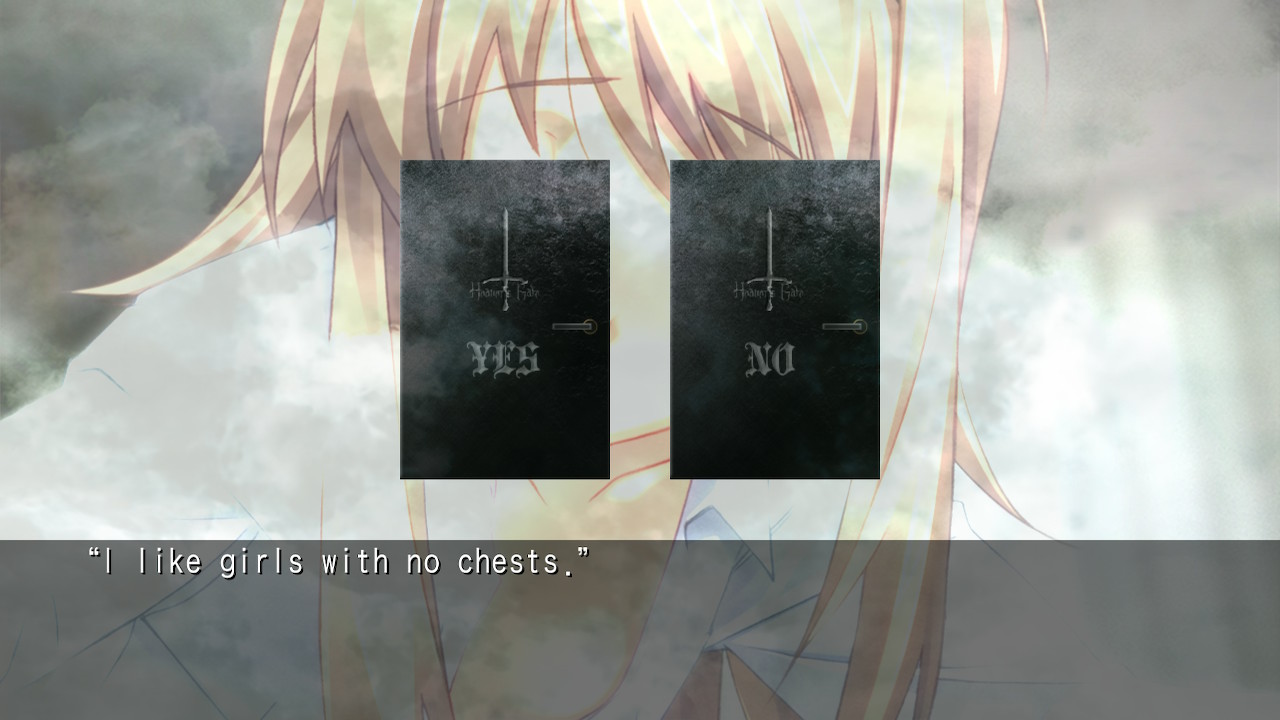
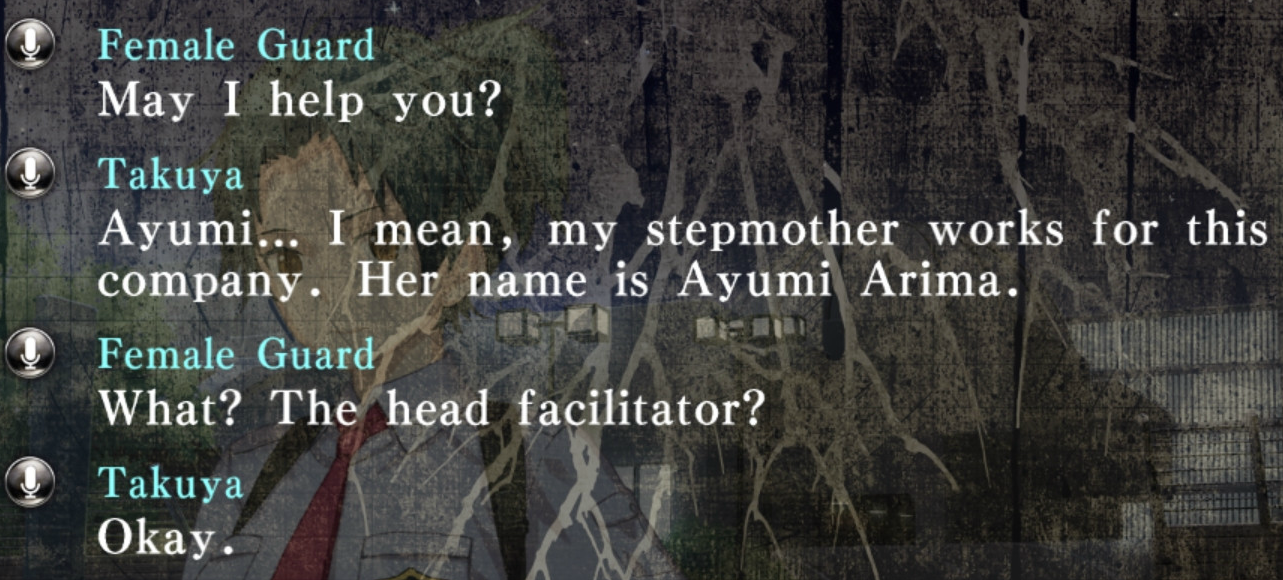
The translation was a disaster. Between its egregious typos, grammar mishaps, and a broadly unpleasant reading experience owed to stiff, overly literal translation writing, calling Never7’s English translation “serviceable” would be giving it too much credit. It exhibits all the warts of amateur translation work, the sort the original authors would be ashamed to see their names attached to. It concerns me that a developer whose entire reputation hinges on good storytelling decided to OK this one for release.
Though Never7 later received an official patch to address some of the bigger issues—perhaps an attempt to bring it more in line with Ever17’s mediocre-to-decent localization—there was no shaking the unpleasant, wooden translation writing that plagued the work throughout, transforming innocuous-at-worst Japanese prose into something cruder and much more difficult to sit through.
MAGES.’ tumultuous trend
I hope these case studies have demonstrated why I’m more than a little concerned about Memories Off’s potential localization. The examples I’ve shared don’t stand in isolation—since 2020, we’ve highlighted numerous different instances of English-localized MAGES. releases with remarkably similar woes in our reviews.
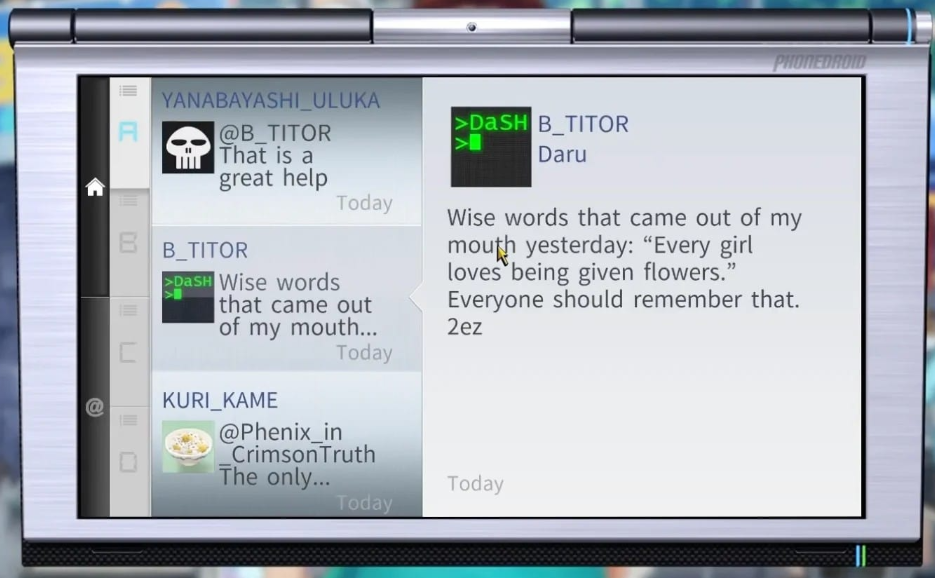
YU-NO (2020) and Chaos;Head NoAH (2022) share Never7’s problems with strange typos, mistranslations, and wooden prose. Like SINce Memories, Steins;Gate: Linear Bounded Phenogram (2019) and Robotics;Notes DaSH (2020) both begin with acceptably polished scripts that fall to pieces over time. In fairness, the recently localized Steins;Gate RE:BOOT (2026) and Anonymous;Code (2023) are the opposite—they’re great examples of solid, passionate localization work. But in a sea of otherwise rocky releases, it’s hard to see them as anything other than exceptions to a dominant trend of inadequacy.
It’s hard to pinpoint specific causes behind these failed localizations, but we can likely generalize the problem as a lack of intentionality. Makoto Asada recently stated, regarding overseas releases of their visual novels, that there’s “an additional need to carefully check that the subtleties of the writing are accurately expressed in the new language.” Yet abject localization failures like Never7, Chaos;Head NoAH, and more suggest this supposed vetting process isn’t being carried out with as much intentionality as these visual novels (and their authors) deserve.
Somewhere along the line, MAGES. keeps failing its catalogue. Maybe they’re choosing the wrong translation partners. Maybe their partners aren’t given enough time, pay, or resources to do the best job possible. The exceptional quality of Anonymous;Code’s 2023 English localization proves success isn’t impossible under MAGES.—but the odds may be stacked against those who work with them.
Dear MAGES.: please don’t fail Memories Off’s English localization
Like many other fans of SciADV and MAGES.’ visual novels, I’ve grown increasingly jaded as the years have brought with them more and more underwhelming English localizations. Yet in recent memory, the Memories Off series has been like a rare ray of light. Playing through its older entries and following the development, marketing, and release of its newest entry, Sousou, has demonstrated to me just how passionately its developer loves the series and wants to see it succeed—even, perhaps, in the face of dwindling sales. For its devoted fans, MAGES. pours its heart into Memories Off. It’s not unreasonable to claim that, at heart, MAGES. are Memories Off fans themselves.
As one such fan from the West and one of the few of my kind (at least for now), this is my appeal: MAGES., I love Memories Off, and I know many of you do too. Please don’t allow its debut in English to fail. Make the effort to choose localization partners who will show it the same care and love you yourselves would. When you do, ensure they have all the time, resources, and funds they need to succeed. Please, break the trend of lacking localization you’ve come to be known for in the West.
KKB Community
0 comments