
Steins;Gate: Octet of Shifting Space is an 8-bit style visual novel released as a bonus for players who bought Steins;Gate RE:BOOT during a promotional period. It is an official English localization of the original game first released in 2011 in Japan, and it’s set after the events of Steins;Gate. In a distinctive twist, this visual novel asks the player to input commands throughout the story in order to progress—strengthening their involvement with the narrative.
Until this release, Steins;Gate: Octet of Shifting Space had only ever been released once, in Japan in 2011. Now, with the official English release, it has finally become easier to experience this unique afterstory.
Note: This review is based primarily on our experience with the Steam version of Octet of Shifting Space.
Story
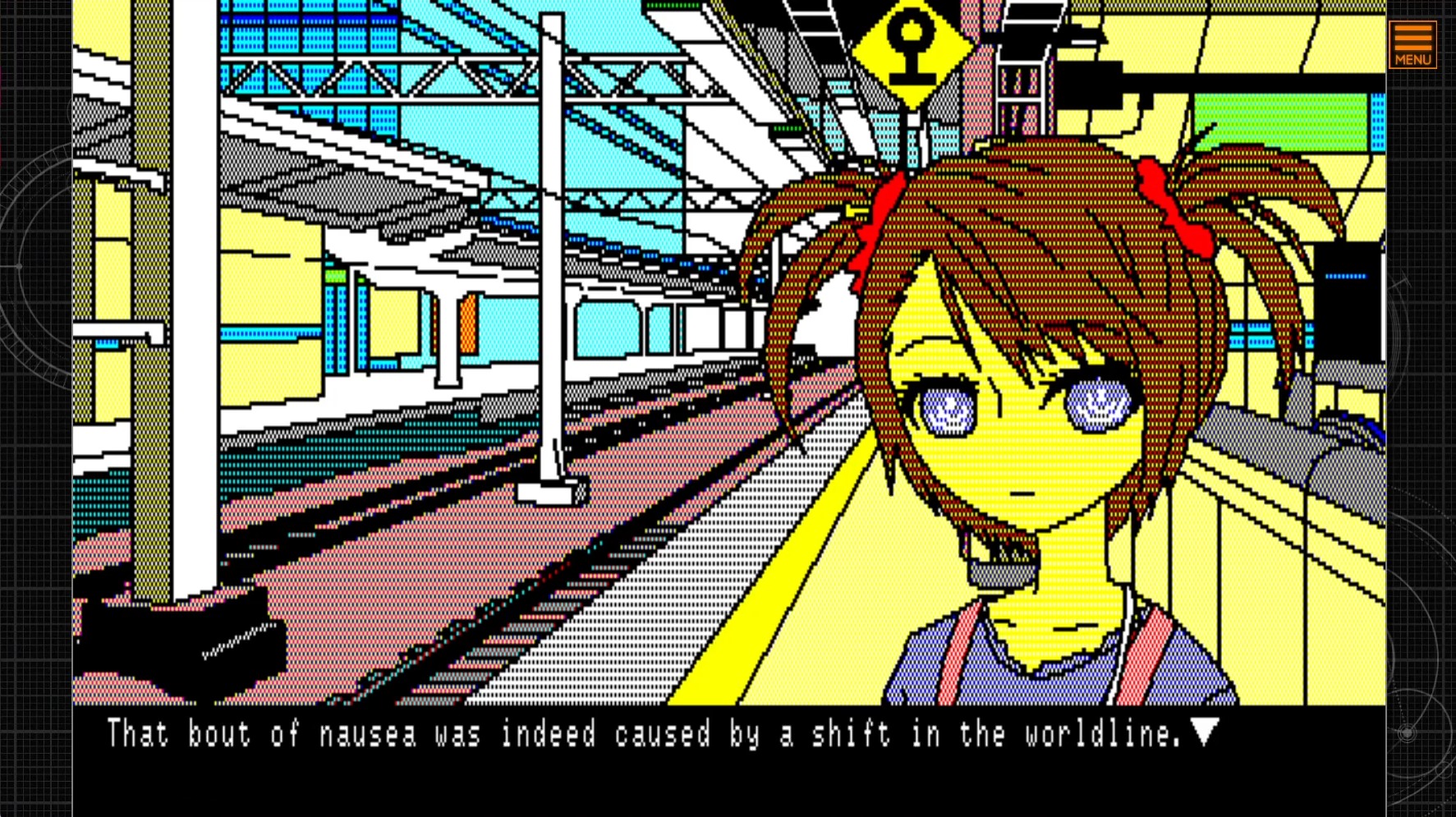
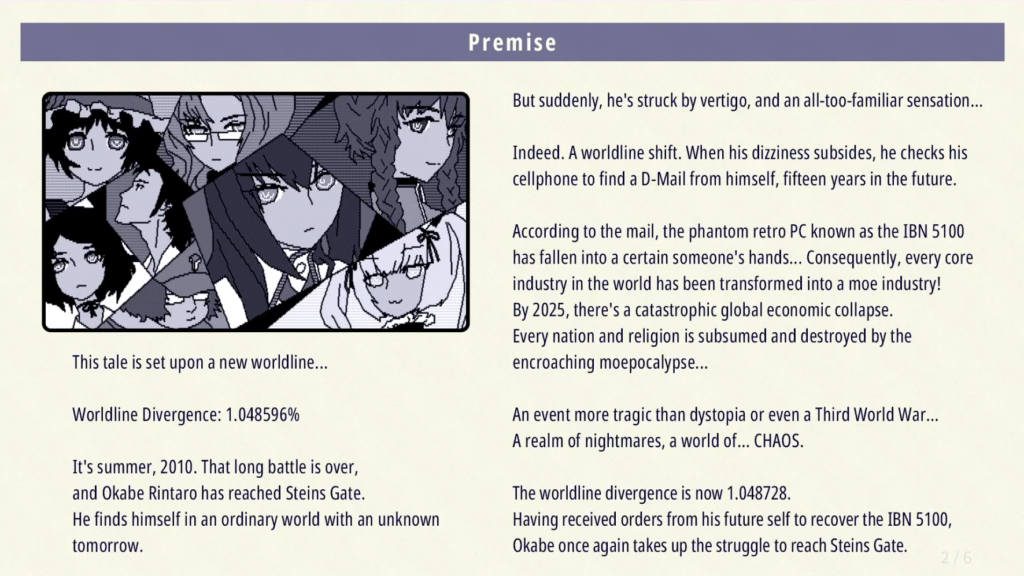
Unlike 8-BIT ADV Steins;Gate, Octet features a fully original story set after the the true ending of Steins;Gate. The story begins with Okabe on a train when, all of a sudden, Reading Steiner activates and the worldline shifts. He receives a D-Mail from his future self revealing that an elusive esper called Neidhardt has stolen the IBN 5100 and transformed all the key world industries into “moe industries” in the future. It is now up to Okabe, and you, to locate the retro computer and prevent another apocalyptic future from coming to pass.
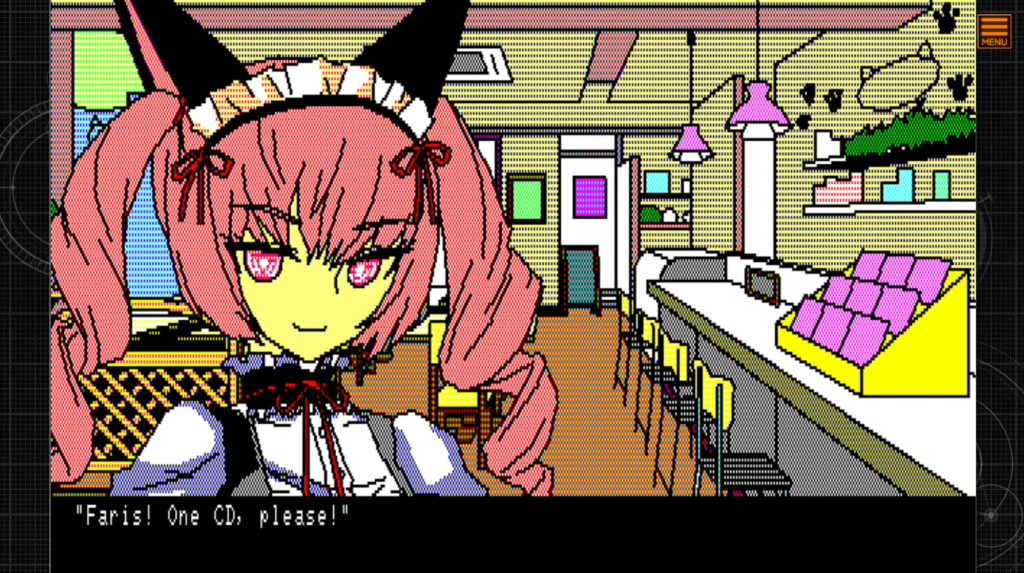
The story does not take itself too seriously, and the dialogue between characters matches that perfectly. It’s an over-the-top narrative full of funny and snarky dialogue, especially between Okabe and Kurisu. Since you can call Kurisu at almost any time during your playthrough, it makes for great banter between them.
While the story has an overall funny and exaggerated tone, toward the climax it becomes surprisingly heartwarming, and I really enjoyed that. The connections to Chaos;Head are a fun touch, and truly eagle-eyed fans may find an interesting potential connection or two to Anonymous;Code.
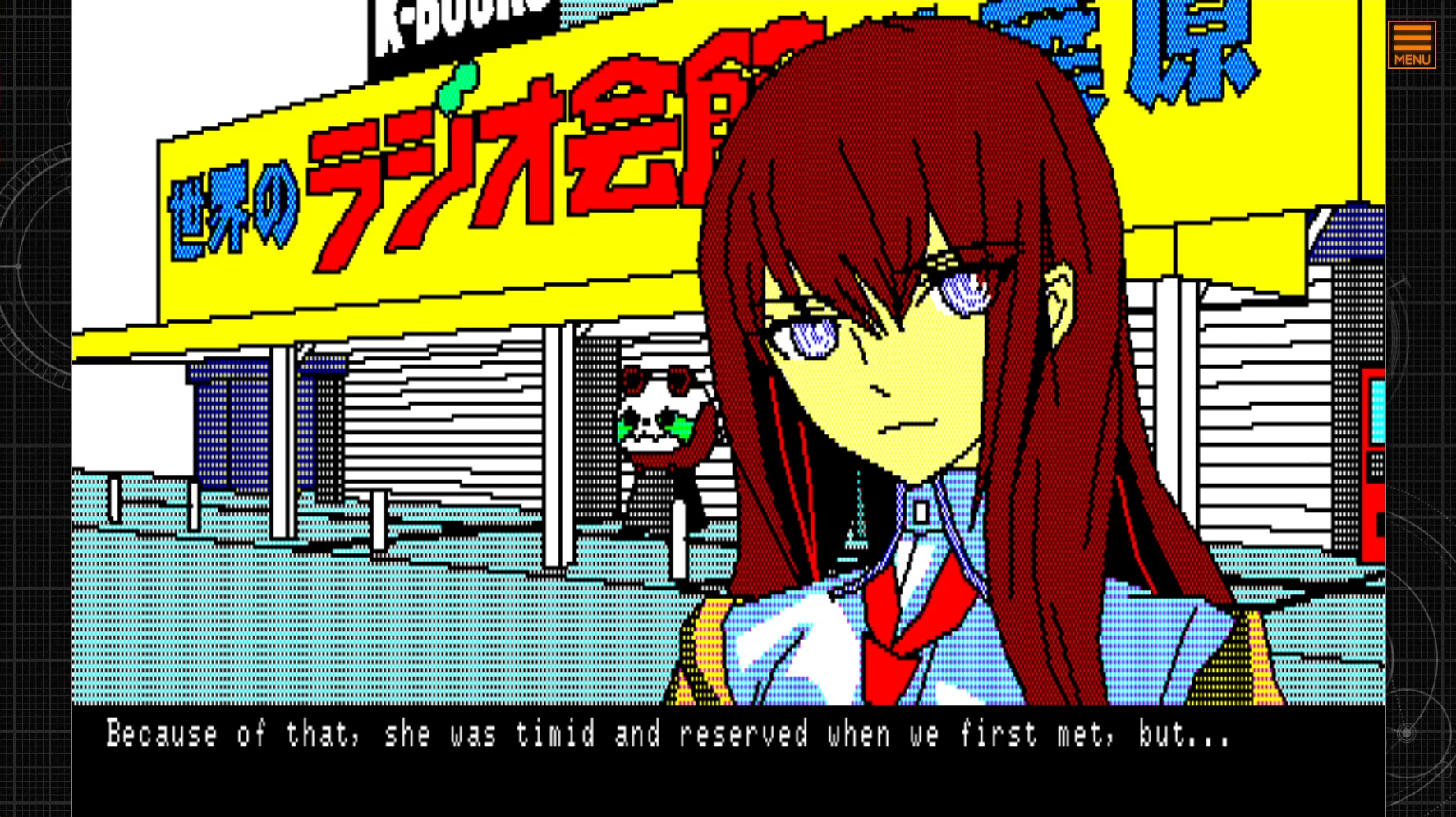
If you only play straight through the story, you can beat the game in an hour or two. However, if you want to see all the dialogue and try different commands, you can easily add another hour or two to that. Since the game’s presentation changes based on the “PC” you select, you can easily jump into another playthrough to see how it looks and sounds. I definitely did.
The official English localization is well done, and we didn’t encounter any noticeable translation issues during our playthrough. As with Steins;Gate RE:BOOT, we do think it could have used a little more proofreading for final polish, but what we received is ultimately pretty darn good, rendering character dialogue and Okabe’s typical chuuni monologues with skill and grace. Overall, we feel the official localization does a strong job of preserving the original experience in a new language.
Presentation
Octet of Shifting Space is a unique specimen these days, given how reminiscent it is of many games developed in the ’90s. Playing it feels like playing an old game in an emulator, and you can even select which retro PC you’re “playing on,” which changes how the game looks, how fast it renders scenes, and even how the audio sounds. As someone who enjoys playing retro games on emulators, playing Octet felt exactly like that, in all the good ways.
Each render mode you select also gets its own unique loading screen, giving it a feeling like you’ve just entered a diskette into a real retro PC. In-game, when you enter a new location, you have to wait a few seconds until the entire scene is “drawn” by lines and colors. This is accurate to the era the game is approximating, but you can still skip the animations by pressing Spacebar or a mouse button.
The game’s sound effects are all retro beeps, and the music is an excellent 8-bit reimagining of the original Steins;Gate visual novel’s soundtrack, even featuring tracks like Skyclad Observer, Gate of Steiner, and others. Each sound and music track also sounds different depending on the render model you select, as each model simulates the sound of that platform. This actually inspired me to play the game again with different settings after I first beat it to experience the differences in soundtracks and visuals in each scene.
Gameplay
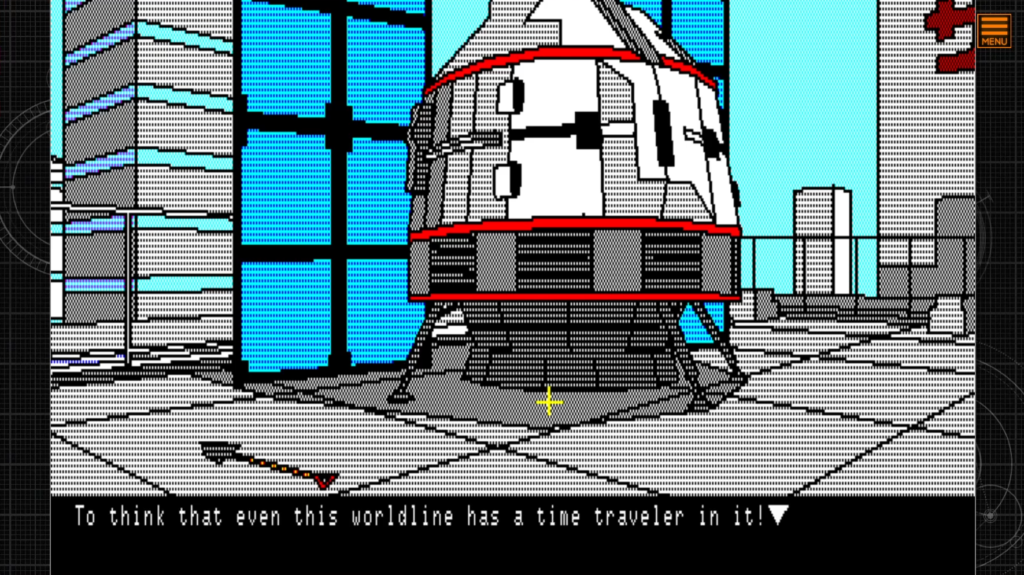
Octet of Shifting Space doesn’t just look like a retro game—it also plays like one. You need to enter various commands to take actions throughout the game. Some commands are obvious and are shown on the screen, while some are hidden; players are able to experiment with their various options. Unlike the original Japanese release, this rerelease offers a guide in the game menu. However, the commands are kept purposefully simple to let players experiment.
Some commands, like kiss, hug, and punch, trigger humorous internal monologues from Okabe. You can also use the command phone to experience Okabe’s chuunibyou firsthand as he talks into it; meanwhile, the assistant command allows you to call your trusty assistant for help.
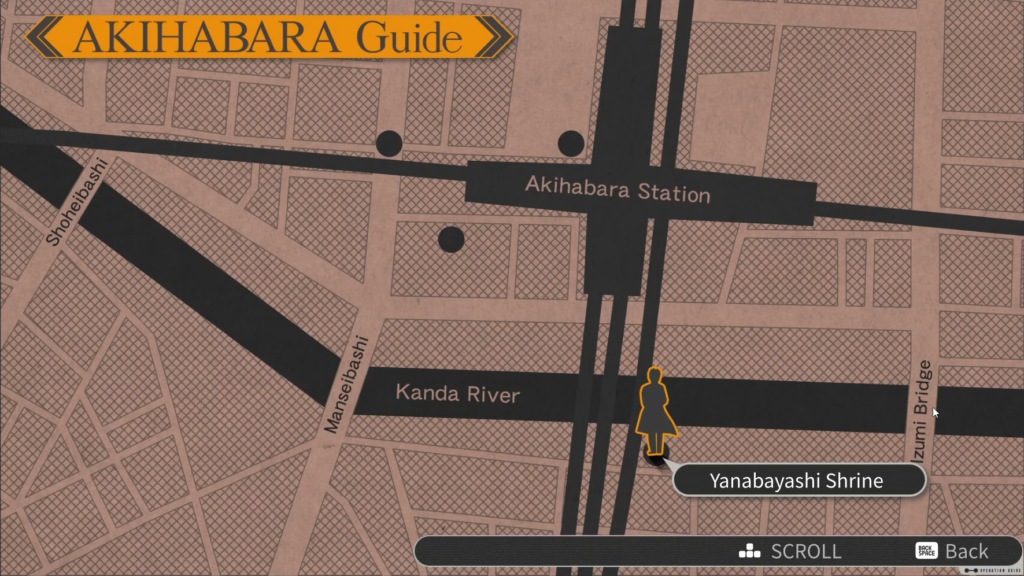
You can move freely through Akihabara by using commands like left, right, back, and front. The original Japanese release featured a physical map as a guide, which has been implemented into the game this time around. You can still easily get lost, though, as the map does not always make clear what you need to type in order to move to certain locations. It is, however, a useful addition to the game.
Availability
Unfortunately, one of the biggest downsides of Octet of Shifting Space is its limited availability. The game is not sold separately and is instead bundled with Steins;Gate RE:BOOT as a digital purchase bonus during a specific promotional period. This means that players interested in experiencing Octet by itself have no way of purchasing it independently and must buy Steins;Gate RE:BOOT alongside it to gain access. Those who bought RE:BOOT physically or on Xbox are also out of luck; RE:BOOT’s physical editions do not include Octet, requiring interested players to rebuy the game digitally, while Xbox has not received Octet at all.
Considering that the game is a relatively short experience, requiring only a few hours to complete, it may be difficult to justify buying an entire fully priced visual novel (possibly twice) just to play this side adventure. We can only hope MAGES. will eventually make Octet available as a standalone purchase so more fans can experience this little bonus story.
Conclusion
Steins;Gate: Octet of Shifting Space is a charming and creative entry that captures the spirit of retro adventure games while delivering a lighthearted and surprisingly funny story. Its unique presentation, interesting command-based gameplay, and great character banter make it an excellent experience for any Steins;Gate fan. While the navigation can be a bit confusing, the game’s humor, atmosphere, and many visual settings give it plenty of personality and replay value. If you’re a fan of the original Steins;Gate and like the 8-bit aesthetic, I think you’ll really enjoy this game.
Octet’s one main downside is that it’s tied to a specific release window and a digital purchase of Steins;Gate RE:BOOT. Owing to this, this short novelty story may not be worth the price of or barrier to entry for everyone.



KKB Community
0 comments