They say no matter how much you struggle, certain events will always converge.
Eight years ago, Kiri Kiri Basara’s first review was for a STEINS;GATE remake. Since then, we have published hundreds of Science Adventure series–related articles, covered countless news stories and game releases, and even traveled to Akihabara ourselves. Yet somehow, we have returned to exactly the same point: reviewing a remake of STEINS;GATE.
Apparently, this is KKB’s very own attractor field. Or perhaps this was always the choice of Steins Gate.
STEINS;GATE RE:BOOT once again brings the story of Rintaro Okabe and the Future Gadget Laboratory to a new generation, this time with completely remade visuals, expanded presentation, and several other quality-of-life changes. But given we’re now on our third version of the STEINS;GATE visual novel, it bears asking: does this new rendition of the narrative justify returning to Akihabara yet again? Let’s find out, fellow observers. You can either watch the video review, or read the article below.
Story (Reviewed by: Bassman)
For the most part, the plot of STEINS;GATE RE:BOOT is the classic narrative fans have always known and adored. It follows self-proclaimed mad scientist Hououin Kyouma and the rest of the ragtag Future Gadget Laboratory as they accidentally uncover a means of time travel via sending emails back to the past. But as they continue to experiment with time travel, they find themselves increasingly entrenched in a conspiracy revolving around the particle physics research organization SERN.
So this is the same story we’ve always known, right? By and large, yes—but it’s not exactly the same. RE:BOOT features a few new narrative additions—the most significant of which is a new heroine route, Moeka’s. Most heroines in the original STEINS;GATE and STEINS;GATE ELITE had a dedicated route, but the one notable exception was Moeka, and some felt her lack of a route made the original game feel somewhat incomplete. For those who felt this way, RE:BOOT rectifies the problem—now, each and every one of the predominant STEINS;GATE heroines has her own dedicated route.
Avid fans of the series may also notice that Moeka’s route appears to be based off of STEINS;GATE Drama CD Gamma, Hyde of the Dark Dimension. However, contrary to what one might expect, Moeka’s RE:BOOT route is actually mostly an original story. It is still loosely based off the aforementioned drama CD, but the plot comprises mostly new content. So regardless of if you’ve listened to Hyde of the Dark Dimension beforehand, Moeka’s route will be material you can enjoy for the very first time.
In addition to the new route, RE:BOOT also adds a few new smaller scenes throughout the rest of the story. Fans of STEINS;GATE 0 in particular may be amused by an additional scene introduced in the middle of Chapter 5. The Suzuha and Faris routes also notably add one additional scene each, which serve to make their respective romances with Okabe a little bit more compelling. The final act of Luka’s route has also been considerably reworked to similar effect. Finally, for longtime Science Adventure fans, there is a short but rather critical post-credits scene past the true ending with relevance to the wider series.
By and large, however, RE:BOOT’s additions are few and far in between. Structurally, it mostly follows the same abridged script that STEINS;GATE ELITE introduced. While some of the descriptive text cut from ELITE is restored in RE:BOOT, the majority of ELITE’s omissions remain missing from the new remake as well. From our calculations of the number of in-game lines, STEINS;GATE ELITE is roughly 67% the length of the original game’s English localization, while STEINS;GATE RE:BOOT is roughly 80% the length. This results in a better-paced version of STEINS;GATE, albeit one achieved at the cost of narrative detail.
Presentation (Reviewed by: Martin)
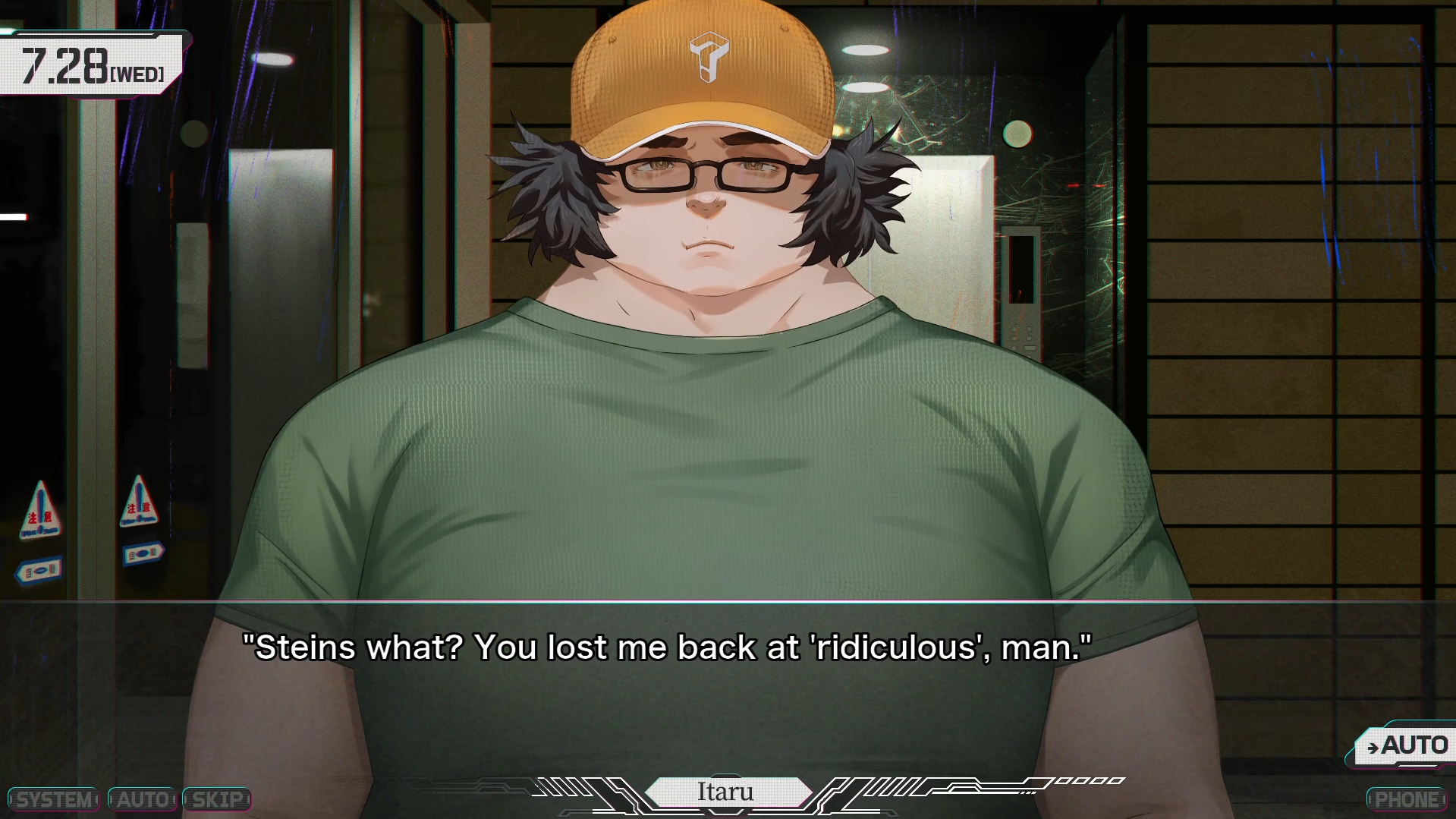
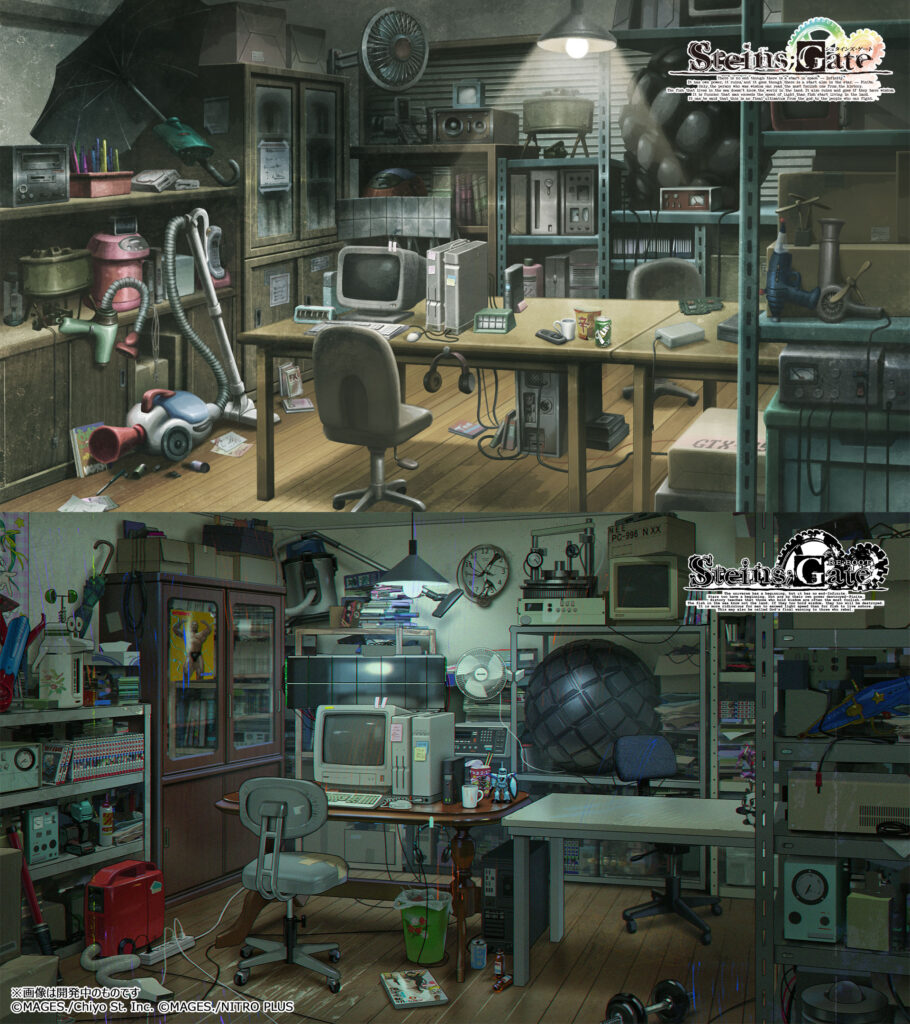
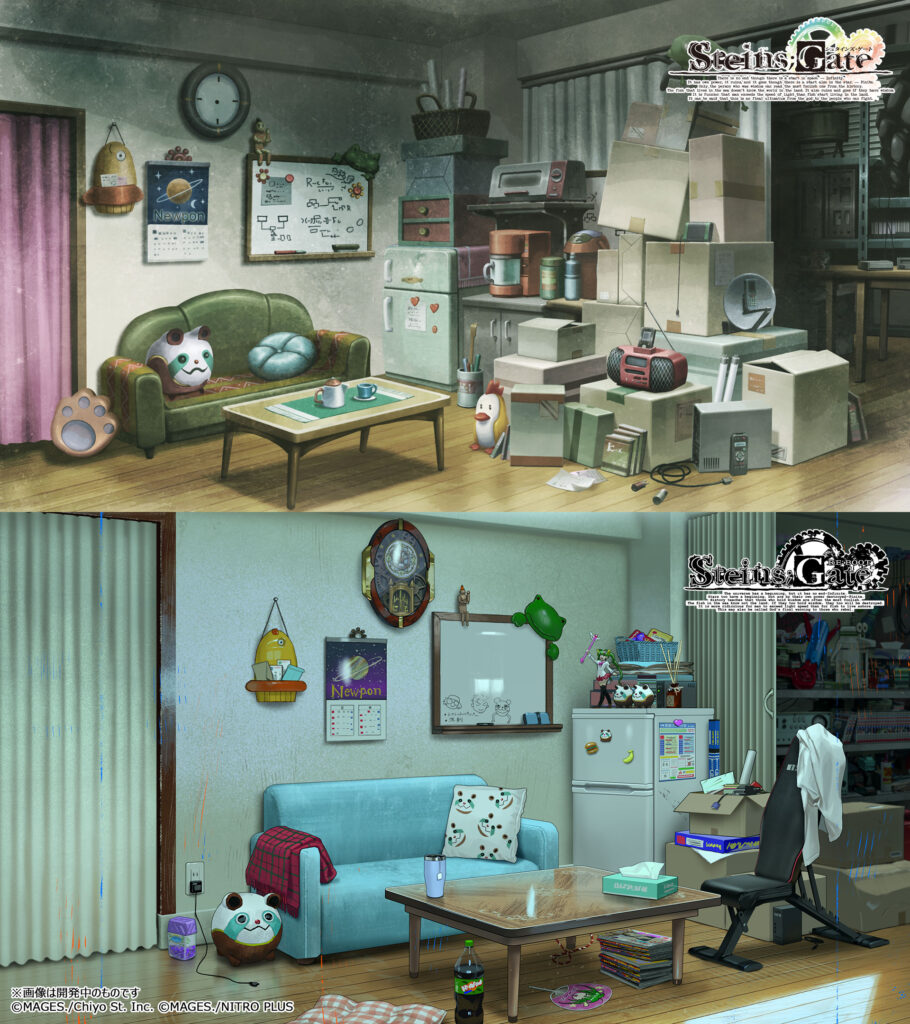
One of STEINS;GATE RE:BOOT’s main selling points is its updated visuals, and honestly, they are among the strongest aspects of the game. The background art of RE:BOOT is so detailed, it could easily be mistaken for genuine photography. The development team previously mentioned taking extra care to recreate Akihabara as it appeared in 2010, and that effort is clearly visible throughout the game.
Many new backgrounds have also been added, enhancing several story scenes and introducing more variety and immersion to the environment of the Electric Town. Having visited Akihabara just a few months ago, I can say I’m rather impressed—the locations presented feel very close to their real-life counterparts.
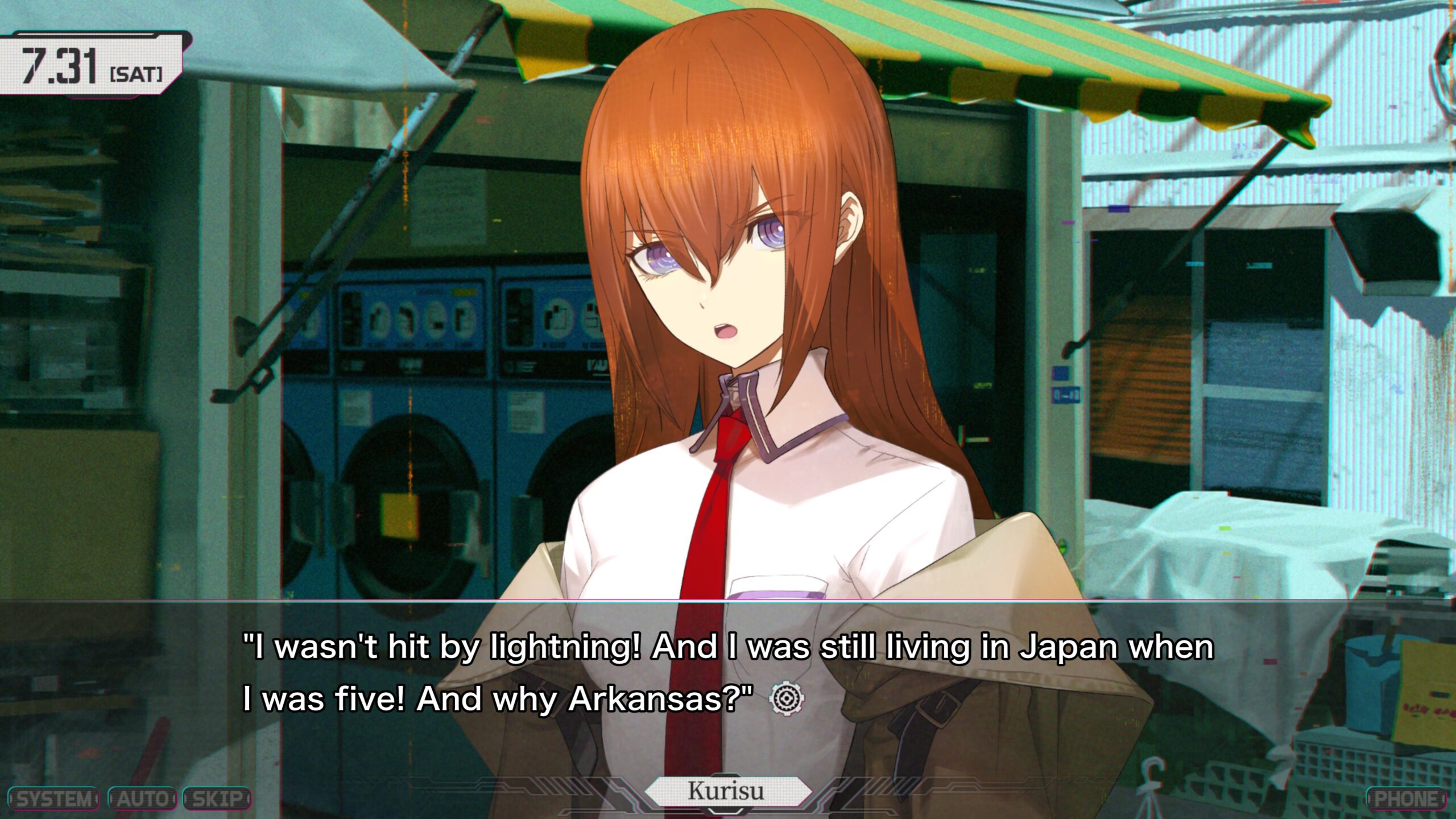
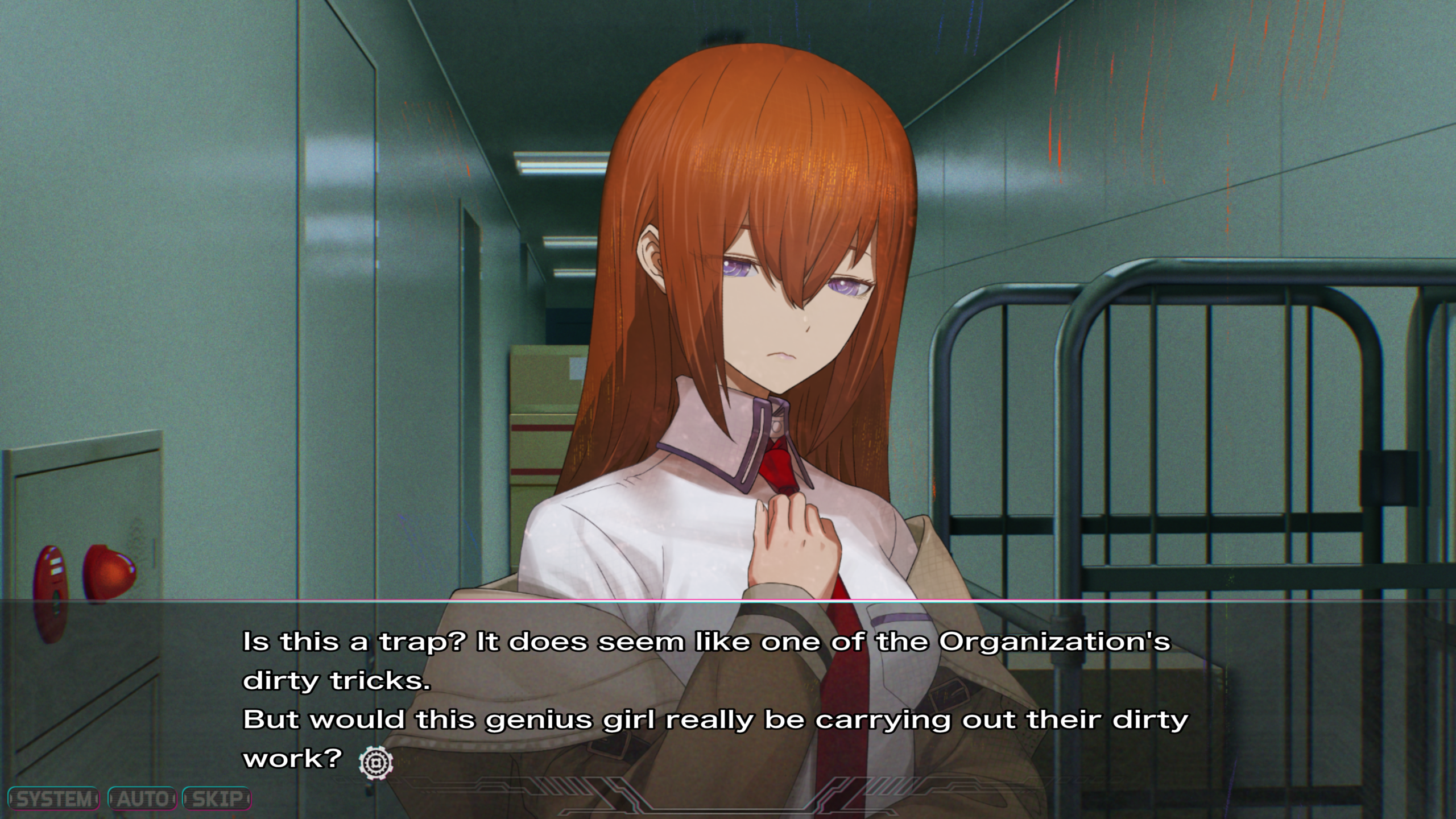
RE:BOOT also introduces updated character art. Rather than the traditional static 2D sprites utilized by STEINS;GATE and STEINS;GATE 0, the characters are now animated in a 2.5D style using the E-mote system, a la ANONYMOUS;CODE. This allows the cast to display a much wider range of expressions and movements.
For those familiar with and accustomed to the original STEINS;GATE’s art style, the updated character art can admittedly take some time to get used to. Once you adjust to it, however, the smaller details—like the characters transitioning from one classic pose to another seamlessly, or their hair moving along with them as they nod, tilt their heads in confusion, or shift backward in shock—help liven up scenes and strengthen the player’s immersion.
The new art style does lose some of the character that defined the original STEINS;GATE, particularly the striking visual identity created by huke (who reprised his artist role for RE:BOOT). On the other hand, we’ve seen a number of opinions over the years from potential players who found the original designs difficult to approach because of how distinctive they were, particularly from that of the anime adaptation, with some never giving the original STEINS;GATE visual novel a chance as a result. In that sense, introducing new, more widely accessible designs may make sense, even if some of the original game’s unique personality has been lost in the process.

The text looks good, and the font can be easily read. However, we did note a semifrequent issue where, if a line had four or more rows of text on-screen, the entire line was compressed to fit. It is a bit baffling that an issue like this made it into the final game, but it thankfully does not occur frequently enough to become a major distraction.
STEINS;GATE’s opening movie and other animated scenes have also been completely remade while remaining faithful to their original counterparts. Despite featuring entirely new visuals, the opening closely follows the style and direction of the original sequence, meaning it feels both fresh and immediately familiar at the same time. The same goes for the end credits sequences and additional animations found throughout the game.
RE:BOOT’s voice acting is another major strength. Every line has been rerecorded for this remake, allowing the cast to draw upon more than a decade of experience portraying these characters. The results are excellent; particularly noteworthy is Mamoru Miyano’s performance as Rintaro Okabe. His delivery of Okabe’s more eccentric and chuunibyou lines is especially compelling, featuring even more energy than heard in the original game.
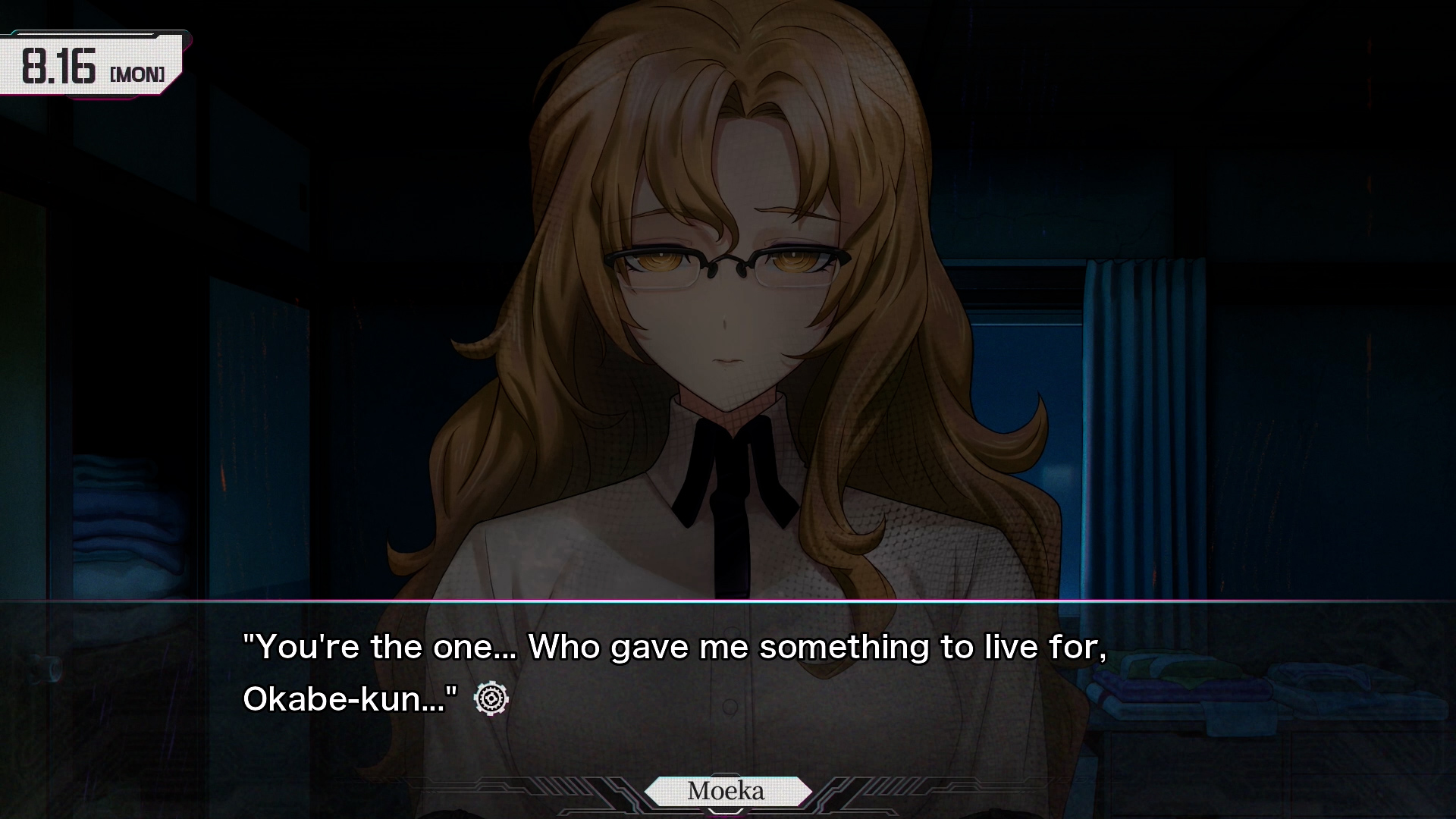
Another standout performance comes from Saori Goto as Moeka Kiryu. With the introduction of her new route, Moeka receives increased screen time and opportunities to shine, which allowed Goto to explore more sides of her personality.
STEINS;GATE’s soundtrack has been completely rerecorded for RE:BOOT, although the track list and overall compositions remain largely unchanged. In that sense, the music reflects the remake itself: it’s close to the same experience as the original, but retuned and repolished for a new release. Some tracks feature only subtle differences from their original counterparts that may be difficult to notice, while others introduce larger changes that returning players will recognize immediately. The result feels both familiar and refreshed, preserving the identity of the original soundtrack while giving it a slightly different feel.
One odd detail we noticed was that a number of RE:BOOT’s menu sound effects appear to have been reused from ROBOTICS;NOTES. Most players will probably never notice this or find it out of place, but after spending countless hours playing ROBOTICS;NOTES, as we have, hearing those familiar sounds in STEINS;GATE can feel a bit strange.
Gameplay (Reviewed by: Martin)
RE:BOOT’s gameplay remains largely identical to the original STEINS;GATE, which is understandable given this is a remake. At four points between Chapters 6 and 9, you are given the choice to either do nothing and enter a character-specific ending, or send an email and continue to the next chapter. Proceeding all the way to the final chapter will lead to Mayuri’s ending, while achieving Kurisu’s ending and the true ending requires the player to correctly respond to Kurisu’s emails throughout the story.
The email system remains effectively unchanged—the same conversations, reply options, and progression triggers are present throughout. The only minor differences we noted were that some emails featured slightly different subject lines or wording.
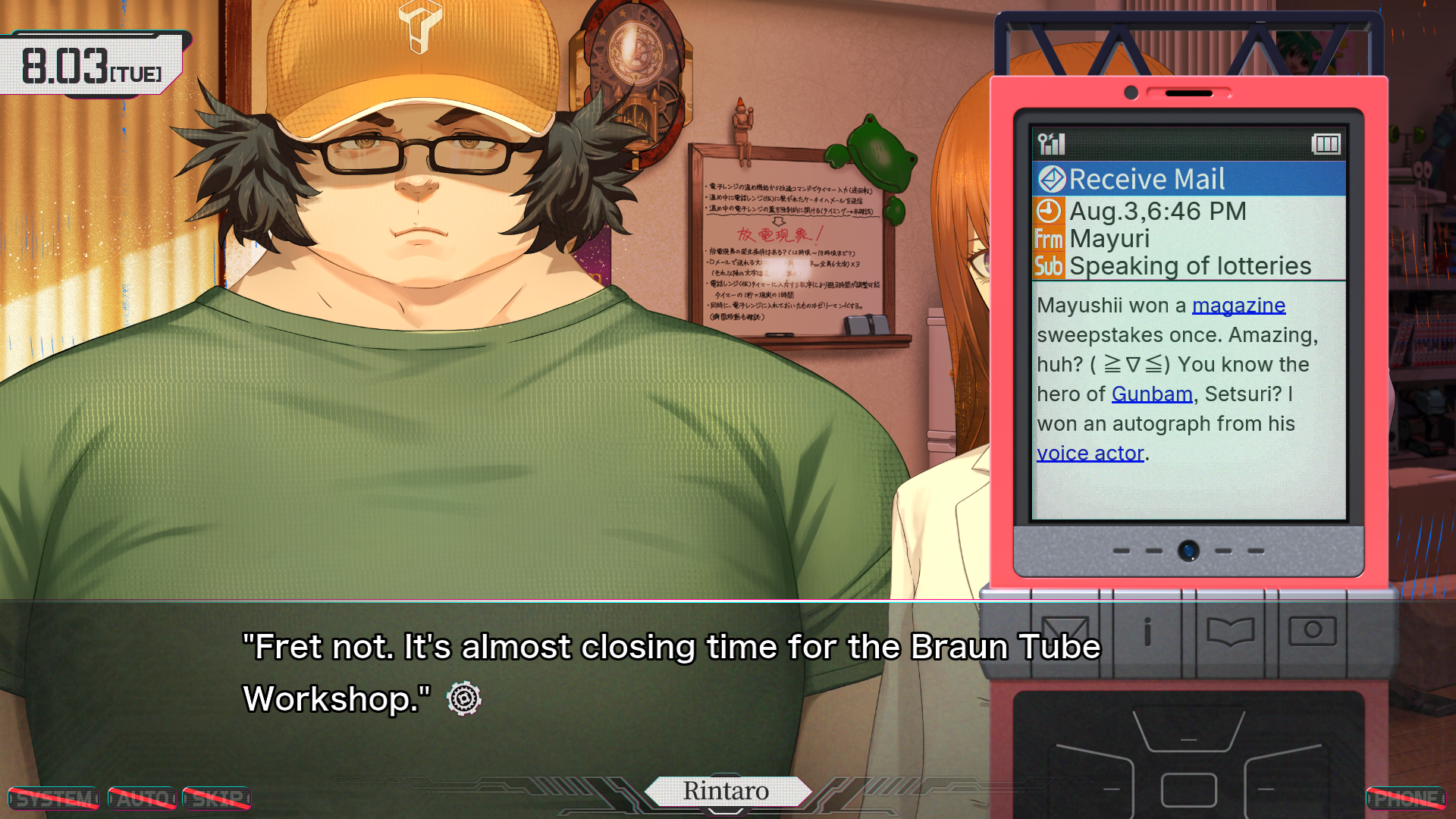
We did sometimes miss an inbound email as we played because the icon indicating an email had been received is not as obvious as it is in the original game. An interesting and welcome presentation change we noted is that when you select a reply, it appears on the screen animated as though Okabe is actively typing it out. The trade-off, however, is that once you have chosen a reply, you can’t back out and select a different reply instead—which was possible in the original game.
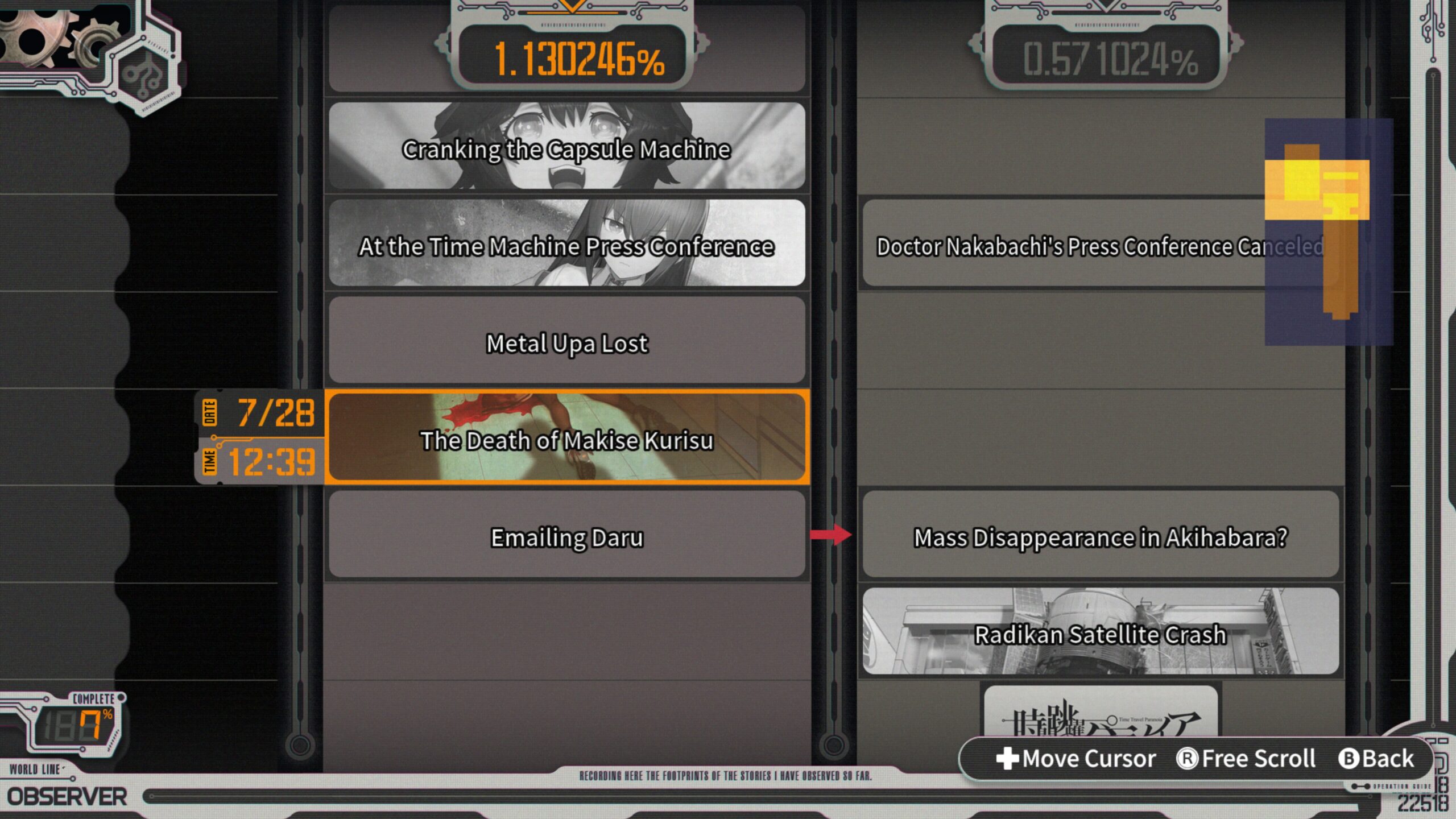
The most significant gameplay addition is the new “Observer” tab found in the menu. This tab allows you to see which events and chapters take place on which worldline, as well as where the individual worldlines diverge. While this is an undoubtedly interesting feature, we would have found it more useful to the player if it allowed you to load and replay the selected sections from the game as well, similar to the flowcharts and chapter-selection systems found in other visual novels. Even within the Science Adventure series, titles like ROBOTICS;NOTES allowed players to replay story segments by selecting them from its in-game calendar.
The Observer tab would also have benefited from an ability to zoom in and out on the timeline. This is by no means a major issue, but being able to view the entire worldline tree at once would provide a much clearer perspective on the structure of the story and its various divergences. Ultimately, while the Observer tab is a neat feature, it could have been much more.
We tested STEINS;GATE RE:BOOT’s controls on keyboard and mouse, an Xbox controller, and even a DualSense controller. Keyboard and mouse functioned without any issues, and controller support was similarly reliable. Xbox controllers are fully supported, with the on-screen button prompts automatically changing to the corresponding Xbox icons. The DualSense also works without any additional setup, although it is handled through Steam Input, which means the game displays keyboard prompts rather than DualSense icons.
The only peculiar issue we encountered was when we attempted to exit the game from the title menu using a controller. Although it is possible to navigate through the rest of the title menu normally, the exit button cannot be selected on controller, meaning that the game must instead be closed using a mouse or keyboard.
Localization (Reviewed by: Enorovan)
On the localization side, STEINS;GATE RE:BOOT continues the streak of great SciADV localizations that ANONYMOUS;CODE started—although this statement will require some elaboration.
To start with the positives, RE:BOOT’s added content, in translation, integrates seamlessly with the existing STEINS;GATE localization (which was repurposed for lines repeated from the original game). Granted, RE:BOOT’s localization was headed by the same core team from STEINS;GATE’s original localization over a decade ago, but that successful integration wasn’t necessarily a guarantee. At any rate, we were impressed to find few to no mistakes in tone, character voice, or era-accurate memes. Similarly, some aspects of the repurposed original script were touched up, mostly for the better, sometimes even correcting decade-old mistranslations that created continuity errors.
We did note a few problems, but rest assured that these were less on the translation side and leaned more toward English syntax. We’re talking about mistakes that are honestly very nitpicky, like punctuation errors, verb coordination issues, missing commas—ultimately, nothing too serious. At the end of the day, our sentiment was, “This was an enjoyable localization—it just could have used a bit more quality assurance.”
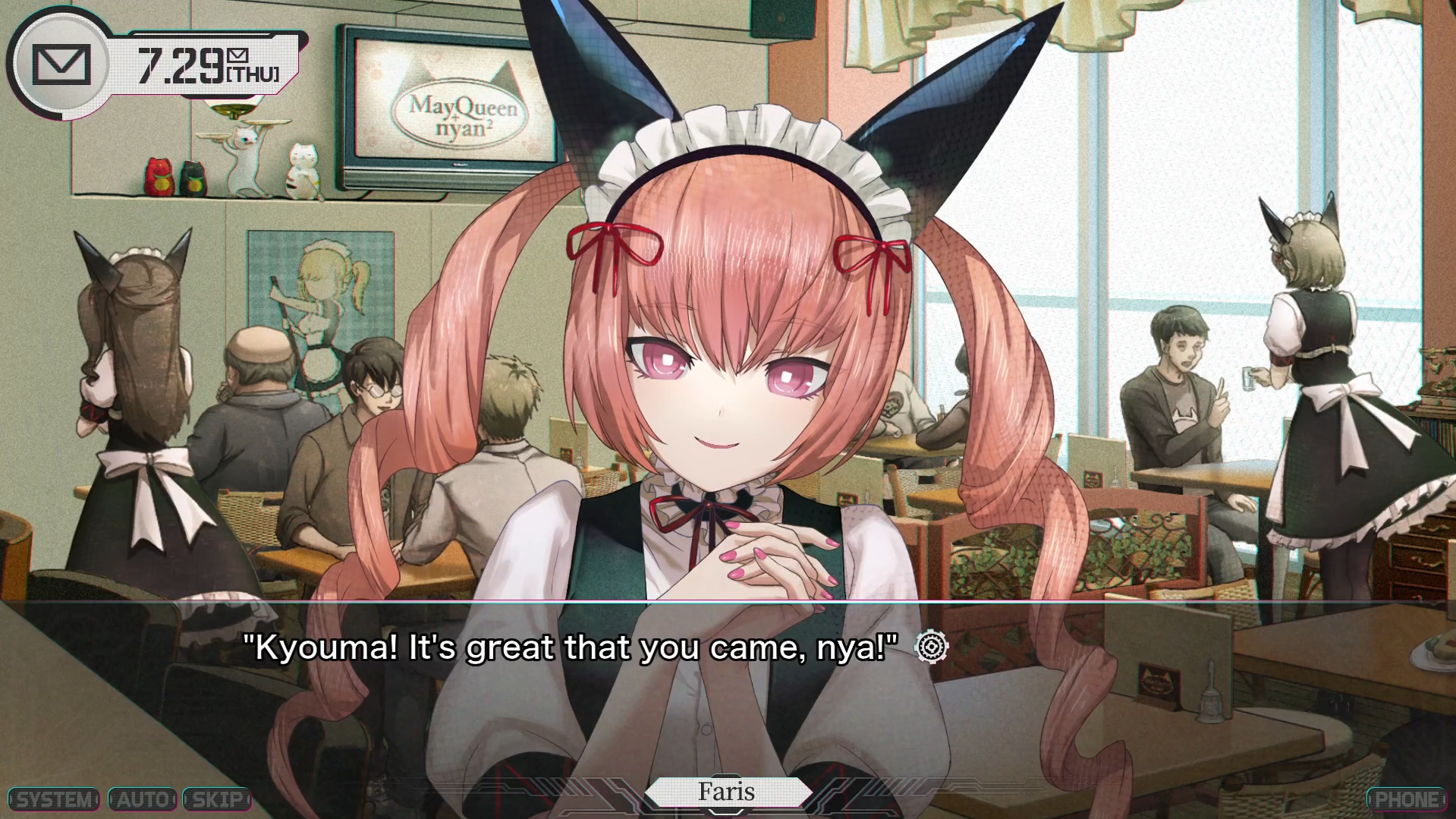
During our review window, the game received an update that reworked a few dozen lines of the story, all of which were improvements that addressed some of the QA issues we noticed. We’re hoping this is an indication that the game may also receive post-launch updates addressing further concerns.
The localization’s biggest flaw lies in its text-heavy visuals. Almost none of the in-game images with text, outside of @channel, are translated into English. And we do mean not translated at all—whereas ANONYMOUS;CODE’s localization translated virtually all the images with Japanese text into English with proper image editing, and STEINS;GATE ELITE at least overlaid soft subs (anime-style subtitles) on the Japanese text for the reader’s benefit, RE:BOOT doesn’t offer any of this. Granted, the number of story-relevant images has fallen considerably compared to the original game (for instance, most of the numerous computer images from the original have been dropped), but this is conversely even more saddening to see, as the remaining content was already translated in the original game’s localization.
Finally, as my colleague Martin mentioned, whenever a line of text is over three rows long, the text is compressed vertically to fit, which can be quite hard on the eye, especially if it happens in quick succession. Potential solutions might have been to reduce the (arguably) large font size and the spacing between each row of text.
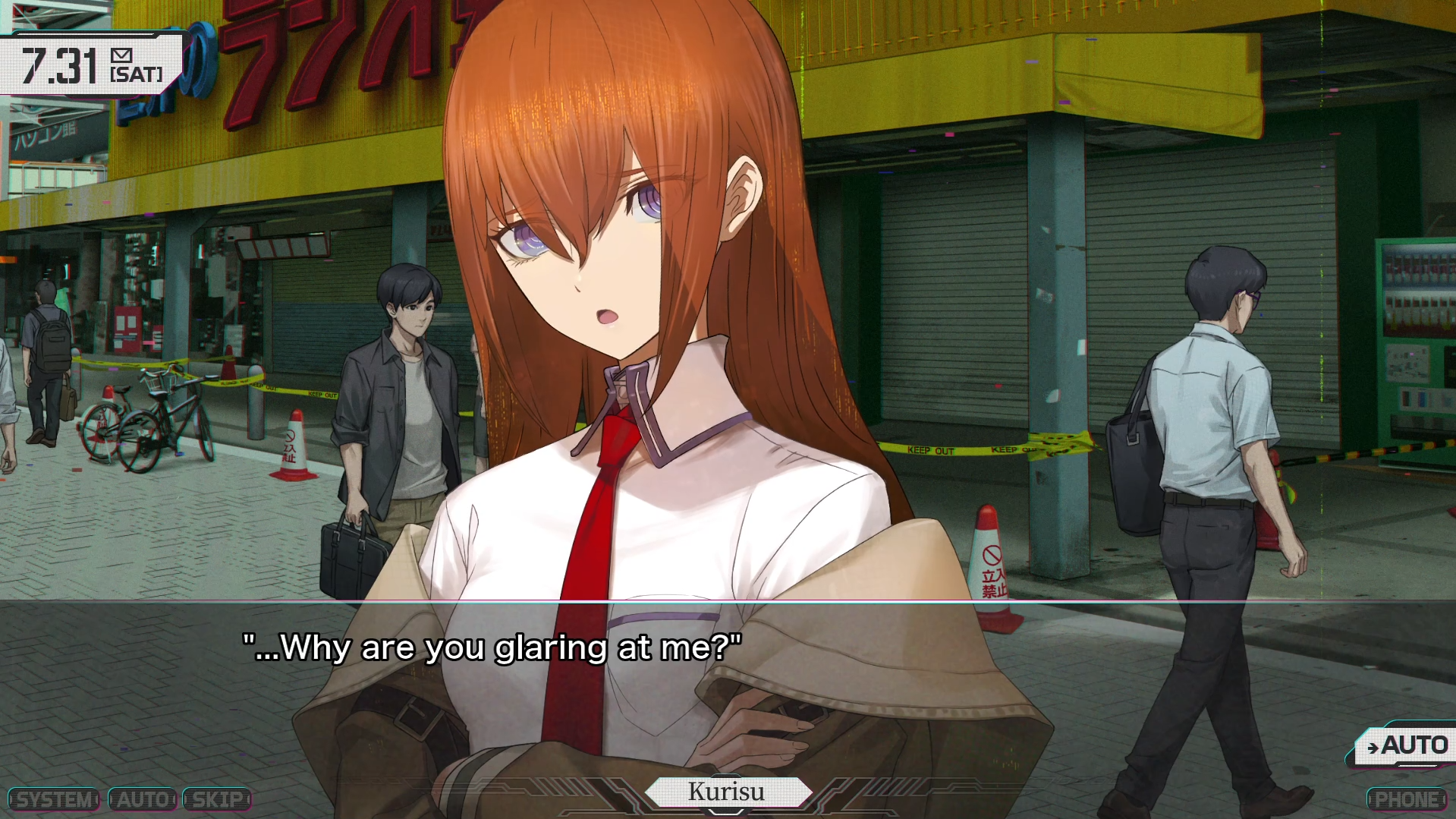
Moreover, where the original game emphasized words or phrases by coloring the text, RE:BOOT opts to use full caps instead. We feel the most elegant solution would have been standard italics.
Ultimately, STEINS;GATE RE:BOOT is one of the better Science Adventure localizations, although its flaws bring it below the stellar ANONYMOUS;CODE and closer to the original game. It bears emphasizing, however, that compared to the general corpus of English-localized visual novels, STEINS;GATE RE:BOOT is unequivocally a very solid localization, and most flaws we have highlighted will be simple nitpicks for the average reader. For that reason, we’d like to extend our congratulations and thanks to the localization team and the publisher, who seem to have heard the community’s feedback and put in the hard work needed to offer a very solid English release.
STEINS;GATE RE:BOOT is a great new way to experience one of the Science Adventure series’s most celebrated stories. Its beautifully recreated visuals, rerecorded voice acting and soundtrack, strong localization, and worthwhile new story content make the return to Akihabara feel fresh rather than unnecessary. However, its condensed script prevents it from fully replacing the original game, while untranslated visual text and several smaller presentation and usability issues keep it from being the definitive version. Nonetheless, RE:BOOT is easily the best choice for console players and an essential addition to the original experience for dedicated STEINS;GATE fans.
Pros:
- Beautifully remade visuals and expressive 2.5D character animation
- Excellent rerecorded voice acting and refreshed soundtrack
- Worthwhile new story content, particularly Moeka’s route
Cons:
- Still uses STEINS;GATE ELITE’s condensed script, leaving much of the original’s detail missing
- Untranslated Japanese text in many visuals hurts the English presentation
- Several smaller UI and usability issues prevent RE:BOOT from feeling like the definitive version
We would like to close with another special thanks to Spike Chunsoft, Inc. for providing Kiri Kiri Basara with an advance copy of the game for review purposes.
STEINS;GATE RE:BOOT launches on August 20, 2026 for PC via Steam, and on October 29, 2026 for Nintendo Switch 2, Nintendo Switch, Xbox Series X|S, and PlayStation 5 consoles. Visit the official website here.



KKB Community
0 comments