
Akihabara is inseparable from Steins;Gate. The streets surrounding the Future Gadget Laboratory are more than a backdrop for Okabe Rintaro and his friends. Radio Kaikan, the cramped electronics stores, maid cafés, railway bridges, and narrow side streets all help give Steins;Gate an unusually strong sense of place. Even if you’ve never visited Tokyo, spending enough time with the visual novel can make parts of Akihabara feel strangely familiar.
Kiri Kiri Basara has explored those real-world locations several times before. During our own trip to Tokyo in January 2026, we visited many of them again, sixteen years after the events depicted in the game. And that raised a slightly different question.
What actually happened to the Akihabara of Steins;Gate?
At first, the answer seems surprisingly simple. Walk around the district today and many of the locations remain immediately recognizable. Streets still follow the same paths, railway bridges still cross above them, and buildings seen in the original game continue to stand.
Some of Steins;Gate’s most recognizable scenery disappeared shortly after the game’s release. Akihabara Station was already undergoing major redevelopment while the visual novel itself was being made. More broadly, Steins;Gate arrived at a very particular moment in the neighborhood’s history when the old electronics district and the emerging center of otaku culture were still visibly coexisting. In other words, Steins;Gate did not simply recreate Akihabara—it unintentionally preserved a city that was already changing.
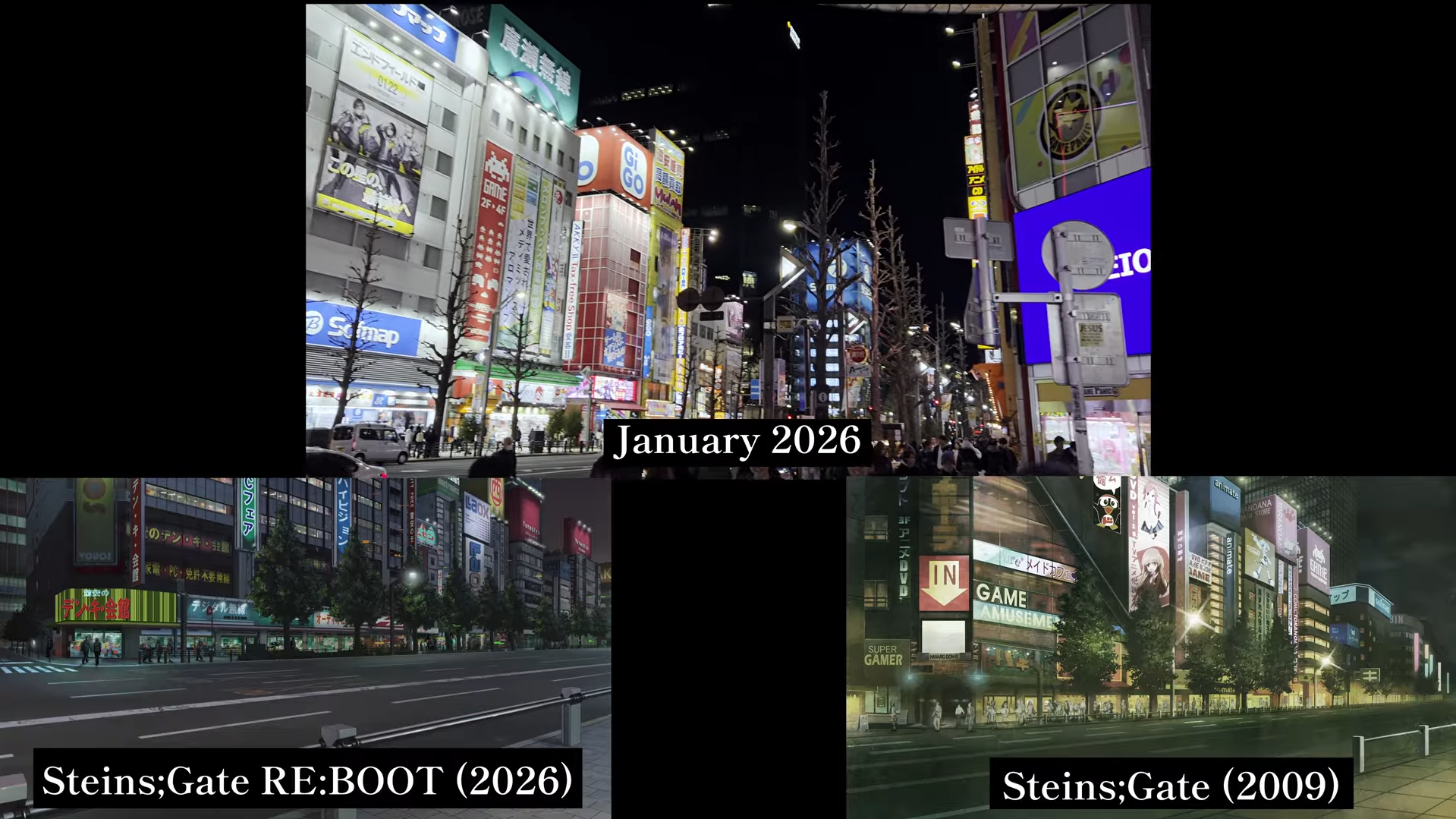
Long before Akihabara became synonymous with anime, figures, and maid cafés, it was the Electric Town. The district’s postwar identity developed around radio parts and electrical components before expanding into home appliances, audio equipment, personal computers, and other electronics. By the 1990s and early 2000s, however, that identity was beginning to change. Anime, video games, and hobby stores increasingly moved into the area. PC enthusiasts overlapped with audiences interested in visual novels, manga, and figures, while maid cafés became another increasingly visible part of the neighborhood.
This transition is visible almost everywhere in Steins;Gate. Daru can wander around searching for computer components, Mister Braun operates a store filled with increasingly obsolete CRT televisions, and Okabe’s search for an IBN 5100 takes him through a neighborhood where tiny specialist electronics shops feel completely at home. At the same time, Faris and Mayuri both work at a maid café; anime and game stores surround the characters; moe culture, games, and internet communities are woven into everyday conversations. Neither side of Akihabara is treated as unusual because, around the time Steins;Gate was being created, both versions of the neighborhood existed simultaneously.
That makes its setting much more historically specific than it might initially appear, and that is most likely the main reason the developers put so much care into recreating it for Steins;Gate RE:BOOT.
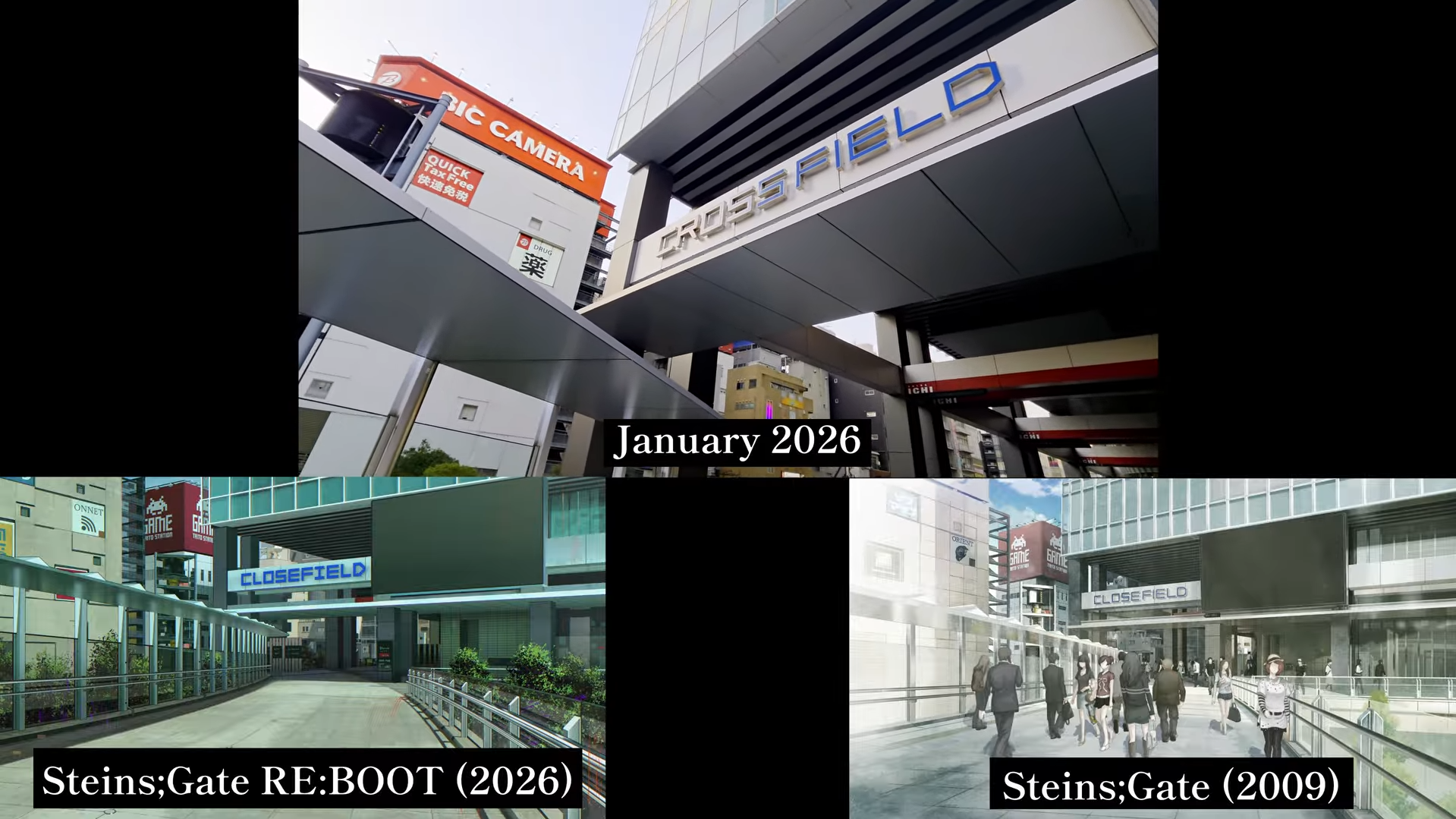
Akihabara Daibiru was completed in 2005, while the enormous Akihabara UDX followed in January 2006. The Tsukuba Express had also begun serving Akihabara in 2005, forming part of a wider redevelopment effort around the station. These newer structures were already part of the world depicted in Steins;Gate. That created one of the setting’s most interesting contrasts: large, modern office and commercial developments stood only a short distance away from cramped electronics stores beneath the railway tracks and aging buildings filled with specialist shops.
One interesting location is the Akihabara Station, a Steins;Gate locale that changed before Steins;Gate even happened. One of the original visual novel’s familiar backgrounds shows the south side of Akihabara Station’s Electric Town Exit. Ticket machines line the wall beneath the station signage, with stores immediately beside them. It’s the sort of background players probably pass dozens of times without paying much attention to it. But by summer of 2010, around the time the story of Steins;Gate takes place, this part of the station had already disappeared in reality.
The Electric Town Exit was undergoing significant construction during the game’s development. The southside route through the concourse was rebuilt in 2009 as work progressed, only months before the original Steins;Gate released in October of that year. The redevelopment itself had begun even earlier. The old Akihabara Department Store, attached to the station since 1951, closed at the end of 2006. Work continued for several years before atré Akihabara 1 opened in November 2010, dramatically altering the appearance of the Electric Town Exit.
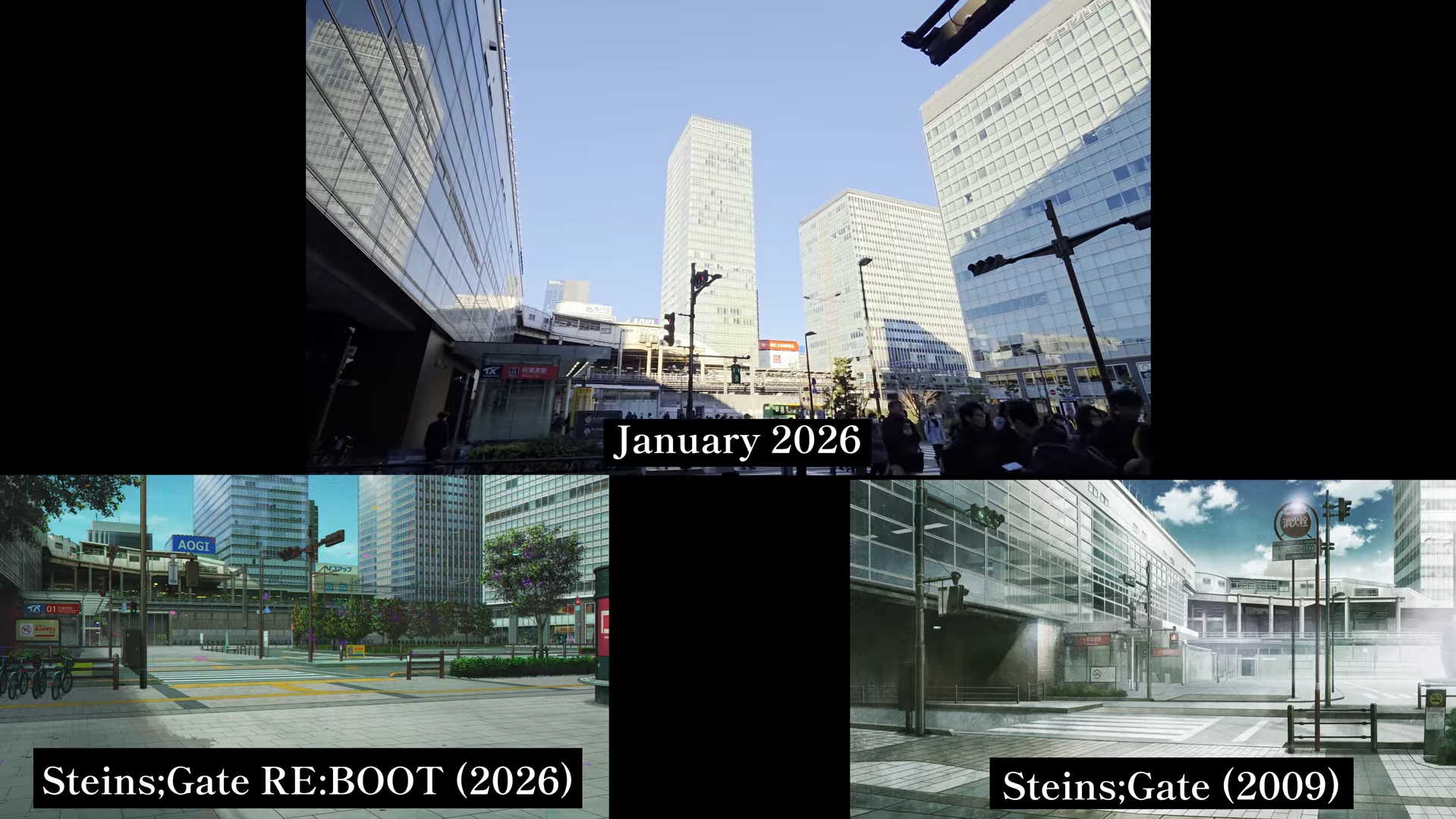
The timing is fascinating. The original Steins;Gate was released in October 2009, but its story takes place the following summer. Its artists naturally had to base backgrounds on reference material gathered during development, meaning parts of its “2010” Akihabara actually represent an earlier version of the city. The game therefore isn’t a perfect photograph of Akihabara on a particular day in July 2010; it is closer to a memory of the Akihabara that existed while Steins;Gate itself was being created. And the station wasn’t the only landmark about to disappear.
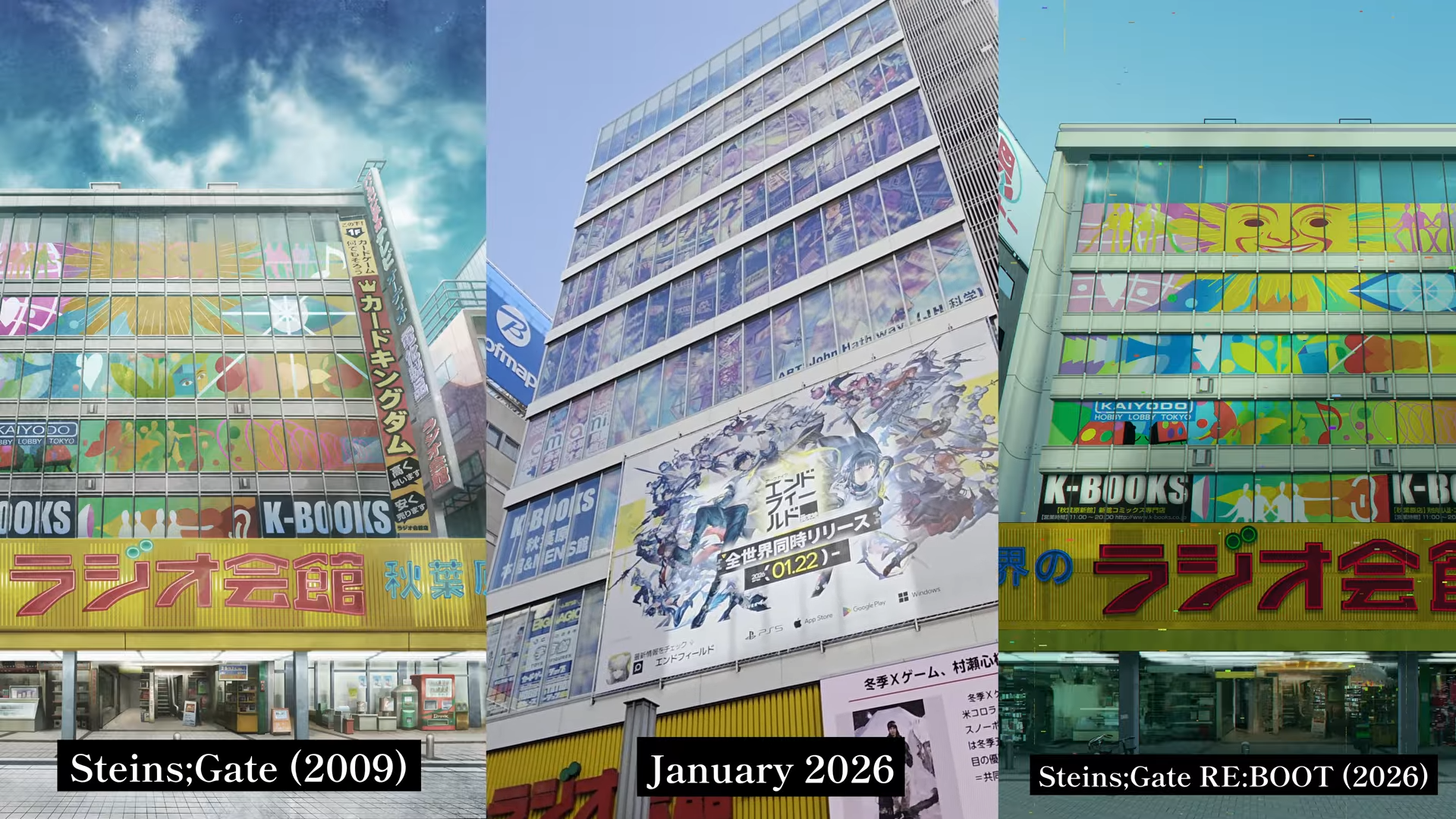
If there’s one real-world building permanently associated with Steins;Gate, it’s Radio Kaikan. The old building towering opposite Akihabara Station dominates several backgrounds in the visual novel and, for obvious reasons, plays a rather important role in the story itself. But Radio Kaikan was significant to Akihabara long before a mystery satellite crashed into its fictional counterpart.
Radio Kaikan’s history neatly reflects the evolution of the entire district. An eight-story Radio Kaikan building opened in 1962, becoming Akihabara Electric Town’s first high-rise building. It helped to establish Akihabara as an important location during Japan’s early personal computer boom. By the late 1990s, companies including K-BOOKS, Kaiyodo, and Volks had moved into Radio Kaikan, illustrating the same transition from electronics toward figures, books, and hobby culture that was occurring throughout Akihabara.
That is essentially the version of Radio Kaikan immortalized by Steins;Gate. Its colorful exterior stands directly across from the station, and unlike the in-game station background, this Radio Kaikan really was still there during the summer of 2010. Just not for much longer. The old building closed on August 4, 2011, less than a year after the period depicted in Steins;Gate. It was subsequently demolished, with the completely rebuilt Radio Kaikan opening on the same site on July 20, 2014.
Modern visitors can, therefore, still walk out of Akihabara Station and immediately see Radio Kaikan—it’s just not the same Radio Kaikan from Steins;Gate. There’s something strangely appropriate about one of the game’s most memorable landmarks becoming one of the first major pieces of its Akihabara to disappear. And yet, surprisingly, little else did.
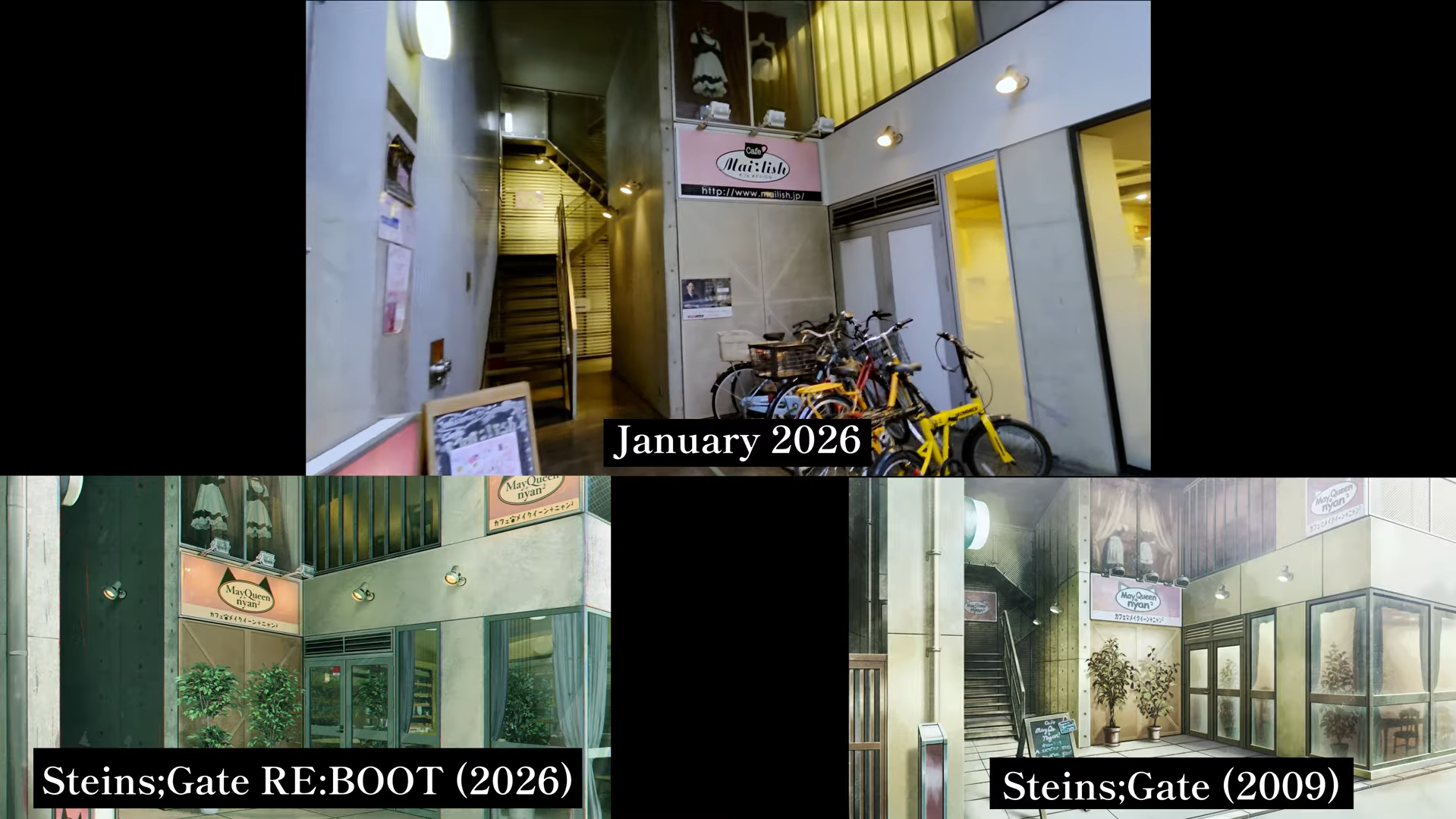
Unlike other SciADV locations like Shibuya, walking through Akihabara in 2026 can feel surprisingly familiar. That was one of the most striking impressions we had during our January visit. The advertisements are different, true, and businesses have come and gone. Storefronts have been replaced, signs have changed, and the crowds walking through the district carry considerably newer phones than Okabe’s. But the physical skeleton of Steins;Gate’s Akihabara remains remarkably easy to recognize.
In some cases, comparing a Steins;Gate background with our footage from 2026 requires surprisingly little imagination. That’s important, because the story of Akihabara since 2010 is not one of everything being demolished and replaced. Much of the change is cultural. Akihabara still sells electronics; walk around the smaller arcades and beneath the railway tracks and remnants of the old Electric Town remain easy to find. But anime merchandise, figures, trading cards, games, themed cafés, and tourism now occupy an enormous part of Akihabara’s identity.
By 2010, Akihabara was also becoming an established international tourist destination for Japanese pop culture. In retrospect, that makes the game’s portrayal particularly interesting. Faris and Mister Braun almost represent two different Akihabaras: one belongs to the increasingly dominant world of maid cafés and moe culture, while the other operates a CRT television shop in a neighborhood built on generations of electronics businesses. And in Steins;Gate, neither feels out of place.
The game happened to arrive while the distinction between those versions of Akihabara was still unusually visible. Even the famous Sunday pedestrian zone on Chuo-dori illustrates how specific that moment was. Following the 2008 Akihabara attack, the pedestrian zone was suspended and did not return until January 2011. That means the famous car-free Sunday streets familiar to many modern visitors were actually absent during the summer in which Steins;Gate takes place. Small details like that make the game’s Akihabara less of a generic anime city and more of a snapshot assembled from one very particular period.
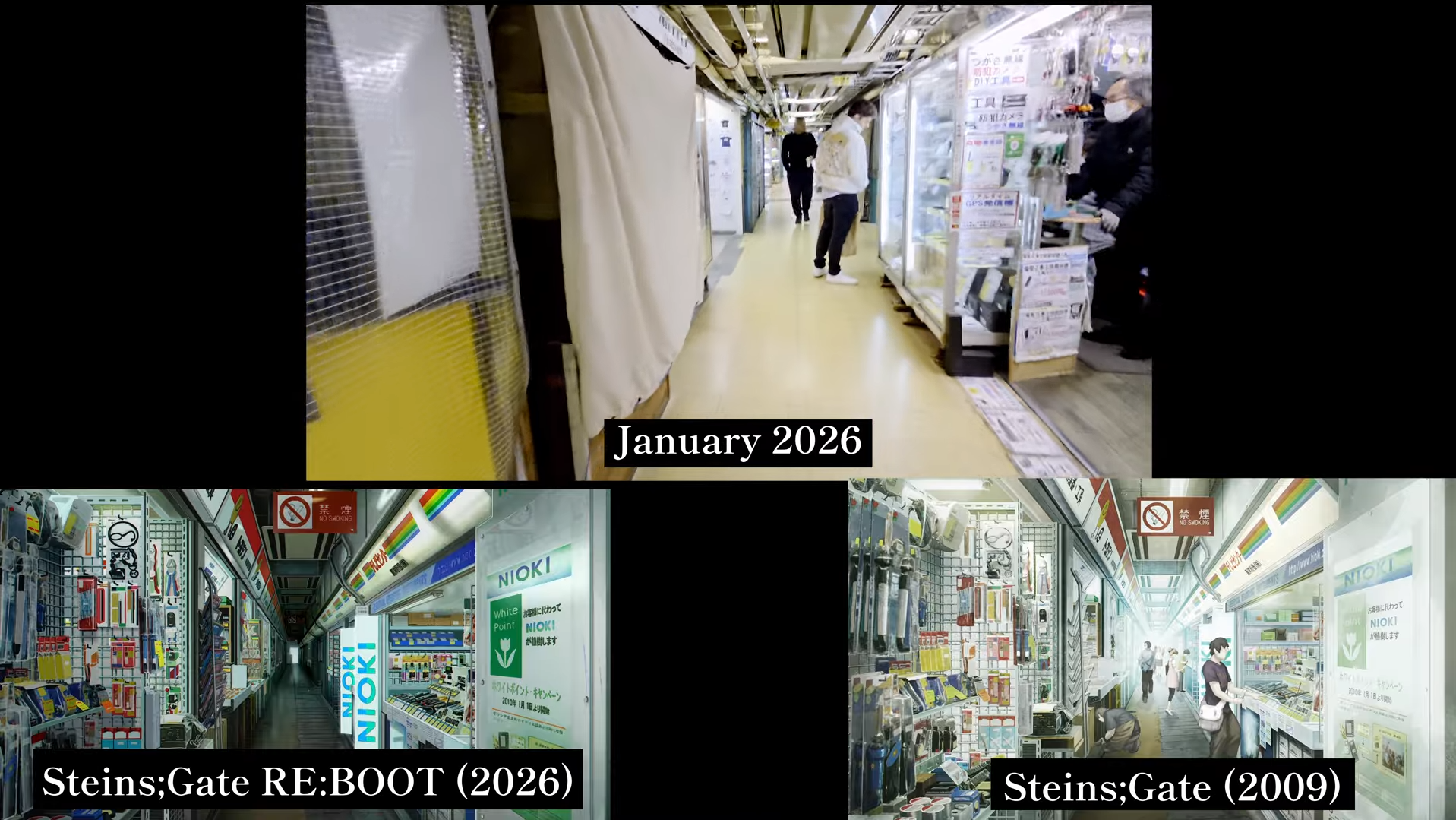
Sixteen years later, Steins;Gate RE:BOOT adds an interesting final layer to all of this. When the original artists produced Steins;Gate, they were largely depicting the Akihabara around them. Even when reference material was already becoming outdated, the city they were drawing was fundamentally contemporary. The artists working on RE:BOOT, however, faced a different task. They were recreating a world from the past.
Radio Kaikan could not simply be redrawn from the building standing outside Akihabara Station today. The station itself had changed. Stores and advertisements had disappeared, and even where buildings survived, the appearances of the surrounding streets had evolved. Importantly, what needed preserving was not necessarily Akihabara exactly as it stood in summer 2010—it was the Akihabara of Steins;Gate. The original visual novel had already blended real locations, development-era reference material, and fictional alterations into its own version of the neighborhood. By faithfully rebuilding those locations, RE:BOOT effectively preserved that same memory in much greater detail.
So, what happened to the Akihabara of Steins;Gate?
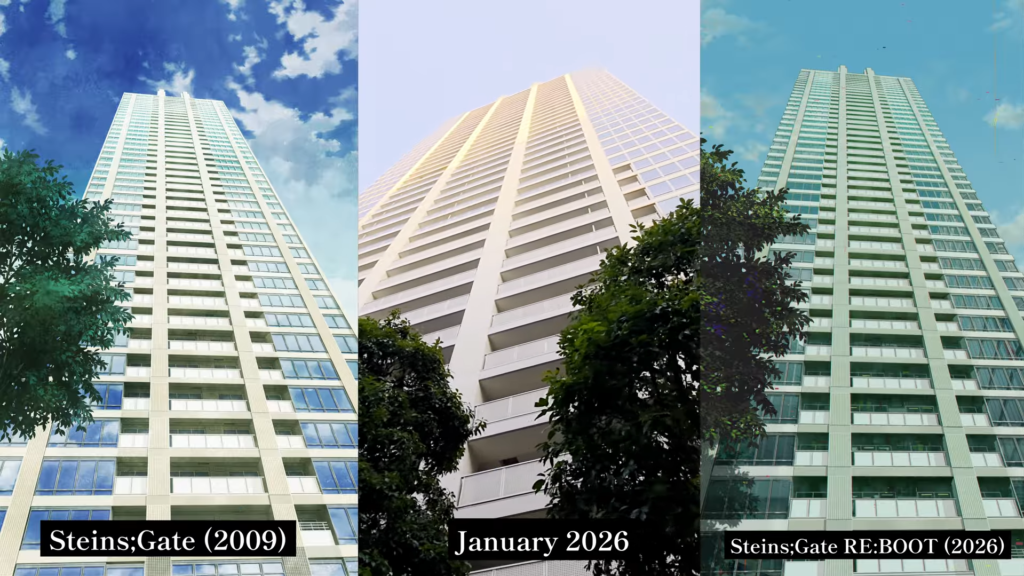
The answer is more complicated than we were expecting when we began comparing the game’s backgrounds with the city today. Some of it disappeared before the story technically even took place. Its most famous real-world landmark survived the events of the game, only to close the following year.
Akihabara Station continued evolving. Businesses disappeared and were replaced. Electronics became less dominant as anime, games, figures, cafés, and tourism increasingly shaped the identity of the neighborhood. And yet, sixteen years later, a surprising amount remains. Walk through Akihabara today and you’ll find that Steins;Gate is still there. Sometimes, it takes an old screenshot to notice it. At other times, you’ll turn a corner or look toward a railway bridge and recognize the view immediately.
When Steins;Gate released, those backgrounds were simply representations of the city surrounding its creators. Today, they have become something else: a record of an Akihabara caught between different eras, preserving buildings, businesses, and pieces of culture that were already beginning to disappear.
For a story obsessed with changing the past, Steins;Gate has become remarkably good at preserving it.




KKB Community
0 comments